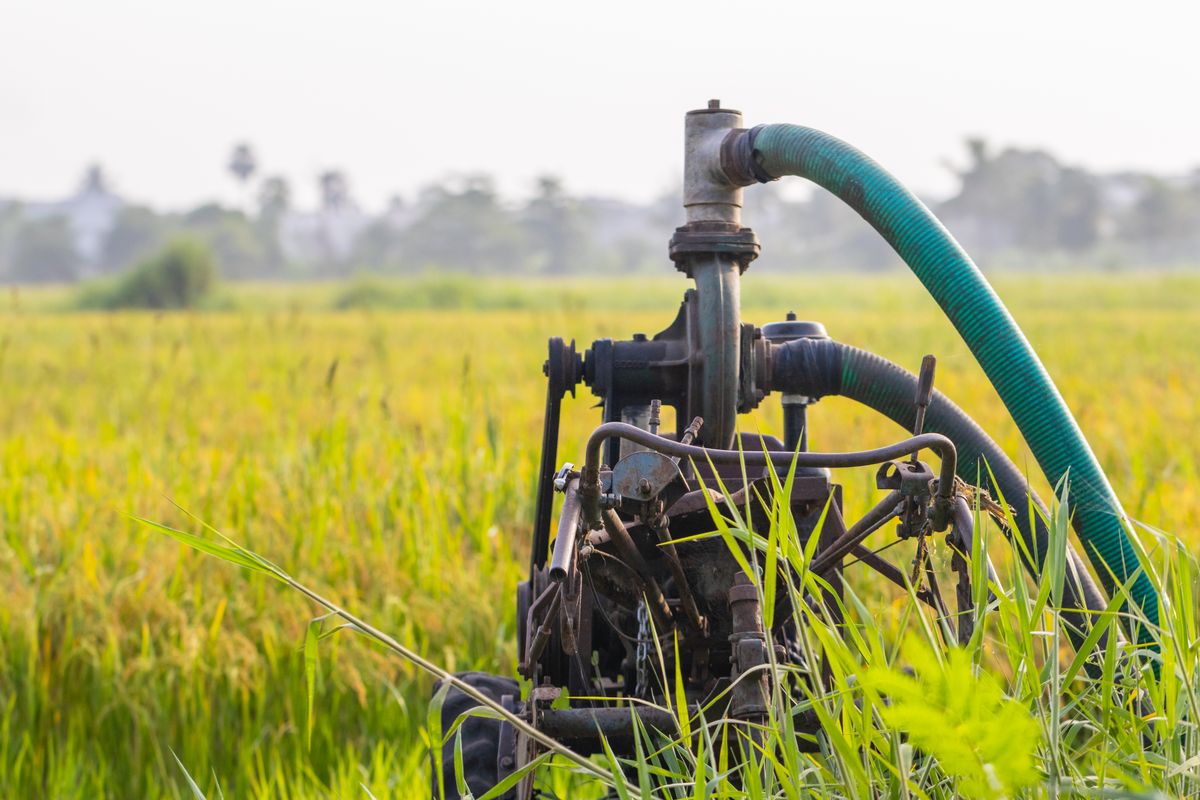
A borehole without the right pump is a hole in the ground. The pump is the working heart of the entire groundwater system — it lifts water from depth, maintains supply pressure, protects the borehole from over-abstraction, and runs reliably for years with minimal maintenance when correctly specified. When it is wrongly specified, the consequences range from inadequate supply to expensive pump failure and borehole damage.
Pump selection is not as simple as choosing the most powerful pump that will fit. It requires matching several interlocking technical parameters — borehole yield, depth to water, total dynamic head, daily demand, power source, borehole diameter, and rising-main specification — into a coherent system that works together reliably over the long term.
This article walks through each of those parameters so that you understand what goes into the selection process, what questions to ask, and what to expect from a properly engineered pump installation.
Why Pump Selection Matters
The two most common pump specification errors in South African borehole installations are oversizing and undersizing — and both cause serious problems.
An oversized pump — one that can deliver more flow than the borehole aquifer can sustainably supply — will pump the water level down faster than the aquifer can replenish it. Once the water level drops below the pump intake, the pump begins drawing air. This is called dry running, and it is one of the most damaging things that can happen to a submersible pump. The motor relies on the water flowing past it for cooling; without water, the motor overheats rapidly and can fail within minutes. A single dry-run event can destroy a pump. Even with dry-run protection installed, repeated cycling at the protection threshold stresses the motor and shortens its service life. Oversizing also over-abstracts the aquifer, which can cause declining water levels over months and years.
An undersized pump — one that cannot deliver enough flow at the required head to meet demand — results in insufficient supply, poor pressure at the tap or irrigation point, and a system that runs continuously without keeping pace with consumption. An undersized pump for an irrigation borehole means the system never fills adequately before the next irrigation cycle. For a household, it means low pressure during peak morning and evening usage.
Getting the specification right from the start, based on the actual yield test data and a proper demand assessment, is the only way to avoid both failure modes.
Key Inputs: Yield, Depth, Demand, and Head
Four measurements form the foundation of every pump selection decision:
1. Borehole yield (litres per hour or m³/h). This is the sustainable abstraction rate established by the yield test. The pump flow rate at operating conditions must not exceed this figure. For safety, most installations are sized to pump at 80 to 90 percent of the tested yield, leaving a buffer against seasonal variation and aquifer fluctuation.
2. Depth to dynamic water level (metres). This is the depth to the water surface in the borehole while the pump is running at its rated flow. It is not the same as the static water level measured when the pump is off — the dynamic water level is always deeper, because pumping draws the water level down. The yield test records the dynamic water level at the tested pump rate, and this figure feeds directly into the total head calculation.
3. Daily water demand (litres per day or m³/day). How much water do you need over 24 hours? For a household, this includes indoor domestic use (typically 150–250 litres per person per day), garden irrigation (highly variable — from a few hundred litres for a small garden to tens of thousands for a large garden or sports field), and any livestock or other uses. For agricultural applications, irrigation demand is the dominant figure and is calculated from the irrigated area, crop type, and system flow rate.
4. Total dynamic head (TDH, in metres). This is the total pressure the pump must overcome to deliver water to its destination. It is the sum of:
- Vertical lift — the distance from the dynamic water level in the borehole to the highest delivery point (overhead tank, pressure vessel, or highest irrigation point)
- Friction losses in the rising main — pressure lost due to water flowing through the pipe. Friction loss increases with flow rate and decreases with pipe diameter. A 25 mm rising main generates far more friction loss than a 40 mm main at the same flow rate — an important reason to size the rising main correctly
- Pressure at delivery — if the system requires a specific minimum pressure at the delivery point (e.g., a pressurised reticulation system), this pressure is added to the head calculation
TDH is critical because pump performance degrades as head increases. A pump that delivers 2 000 L/h at 30 metres of head may only deliver 1 200 L/h at 80 metres of head. Selecting a pump based on its flow rating at low head, without checking the performance at your actual TDH, is a frequent and expensive error.
The pump curve: Every submersible pump has a published performance curve — a graph of flow rate vs. head. Your system also has a curve — a line showing the head required at each flow rate. The operating point is where these two curves intersect. A correctly sized pump has its operating point in the efficient mid-range of its curve, not at the extremes where efficiency drops and wear increases. Everest Drilling selects pumps using this curve-matching method — not by rule of thumb.
Submersible Pump Types: Multistage, Single-Impeller, and Brands
The standard pump for deep borehole installations in South Africa is the submersible centrifugal pump — a sealed unit comprising a motor and one or more pump stages, installed below the water level in the borehole on the rising main. All current servicing is done by pulling the pump to surface; there are no accessible moving parts above ground during operation.
Multistage submersible pumps are the most common type for boreholes deeper than about 30 metres. Each "stage" consists of an impeller and diffuser that adds pressure (head) to the water. More stages mean more head capability at a given flow rate. A 4-stage pump at a given impeller diameter generates roughly twice the head of a 2-stage pump of the same size. This makes multistage pumps well suited to deep boreholes where the TDH is high — a borehole with a dynamic water level at 80 metres and an overhead tank 10 metres above surface requires a pump capable of at least 90 metres of head, which typically requires four or more stages in a standard 4-inch pump body.
Single-impeller (single-stage) pumps are suited to high-flow, low-head applications — shallow boreholes with high yield, or boreholes where the TDH is modest. They tend to be less efficient at high head than multistage units.
In terms of brands commonly used in South Africa, three names dominate quality borehole pump installations:
- Grundfos (Denmark) — widely regarded as the benchmark for borehole submersible pumps in terms of reliability and engineering quality. The SP and SQ series cover most residential and light commercial borehole applications. Grundfos pumps are higher in upfront cost than some alternatives but have a strong track record for long service intervals and good parts availability.
- Franklin Electric (USA) — particularly well regarded for borehole motors, Franklin is often found paired with various pump ends in complete systems. Franklin motors have excellent thermal protection and a long service history in harsh South African conditions.
- Pedrollo (Italy) — offers a value-positioned alternative in the submersible pump market, with a broad range covering residential boreholes. Pedrollo pumps are widely distributed in South Africa and offer good performance for their price point in moderate-depth applications.
For solar borehole applications, pump selection must also consider compatibility with variable-frequency drive (VFD) operation, since solar pump controllers vary the pump speed with available solar power rather than running the pump at fixed Eskom frequency. Not all conventional AC submersible pumps perform optimally under VFD control — purpose-designed solar pump systems (such as the Grundfos SQFlex or equivalent) are engineered specifically for variable-speed solar operation and deliver better long-term reliability in this application.
Solar Pump vs Grid-Connected Pump: When to Choose Each
The choice between a solar-powered pump system and a grid-connected system is one of the most consequential decisions in a borehole installation, affecting capital cost, operating cost, reliability, and maintenance requirements.
Solar pump systems are the right choice when:
- The property experiences frequent load shedding and water supply continuity during Eskom outages is a priority
- The property is off-grid or the cost of grid connection is high (many agricultural and rural sites)
- There is adequate solar irradiance — South Africa's solar resource is generally excellent, and most parts of the country receive sufficient daily sun hours for effective solar pumping
- The water demand is reasonably predictable and can be accumulated in a storage tank during daylight hours
- The long-term operating cost reduction from eliminating electricity consumption justifies the higher upfront capital cost of the solar array and controller
The key design consideration for solar borehole systems is that the pump only runs during daylight hours (or during battery-stored periods if battery backup is included). The system must be designed so that the volume pumped during the available solar window meets the daily demand, with sufficient tank storage to cover overnight and cloudy-day demand. A correctly sized solar system with a 5 000- to 10 000-litre overhead tank is genuinely resilient — continuous supply regardless of load shedding schedule, Eskom tariff increases, or grid disruptions.
Grid-connected pump systems remain appropriate when:
- The property is reliably grid-connected and load shedding is infrequent or managed by generator
- The demand profile requires pumping at any time of day or night, including hours when solar is unavailable
- The capital budget for the pump installation is limited and a phased approach (grid now, solar conversion later) is planned
- The borehole yield is very high and the pump runs only briefly each day — in this case the electricity cost is modest and the solar array cannot easily be justified
Many properties use a hybrid approach: a solar pump controller that runs the pump from solar during the day and switches to grid power when solar output drops below the pump's operating threshold. This maximises solar utilisation while maintaining supply continuity without the cost of a battery storage system.
Pump Control Panels: Dry-Run Protection, Soft-Start, and Pressure Control
A borehole pump without a properly configured control panel is an incomplete and potentially vulnerable system. The control panel is the brain of the pump installation — it monitors operating conditions, protects the pump and borehole from damage, and manages the pump's interaction with the storage and distribution system.
The minimum protection features required on any borehole pump installation are:
Dry-run protection. This is the most critical safety feature. A dry-run protection device — typically either a pressure sensor, a float switch in the borehole above the pump, or a current-monitoring relay — detects when the pump is running without adequate water and trips the circuit before the motor overheats. Some systems use a time-delay restart cycle: after a dry-run trip, the pump waits a set period (typically 30 to 60 minutes) before attempting to restart, allowing the borehole to recover water level. Without dry-run protection, a single low-water event can destroy an expensive submersible pump.
Soft-start. A soft-start module ramps the pump motor up to full speed gradually rather than applying full voltage instantaneously. This reduces the mechanical shock on the pump coupling, motor bearings, and rising-main joints at startup — extending the service life of all these components. In a borehole with many daily start-stop cycles, soft-start is particularly beneficial.
Pressure control and tank-level management. The control panel connects to a pressure transducer or float switches in the overhead storage tank to manage when the pump runs. Typically, the pump runs until the tank reaches its high-level set point, then stops. When the tank drops to the low-level set point, the pump starts again. This tank-fill control strategy accumulates water efficiently regardless of instantaneous demand patterns in the building.
Overload and undercurrent protection. Overload protection trips the pump if it draws more current than its rated value — indicating a blocked impeller, a motor fault, or excessively high head. Undercurrent (or "no-load") protection detects when the pump is spinning but drawing below-normal current — a sign that the impeller is churning air rather than water (i.e., dry running), even before a pressure sensor would register a fault.
For solar pump controllers, additional functions include MPPT (maximum power point tracking) to optimise the power drawn from the solar array at varying irradiance levels, and a low-sun speed reduction that runs the pump at reduced speed during early morning and late afternoon when solar output is below full capacity, rather than cycling the pump on and off.
Drop-Pipe and Rising-Main Material
The rising main — the pipe that carries water from the pump to the surface — is a critical component that is often underspecified in budget installations. The three main materials used in South African borehole installations each have distinct characteristics:
uPVC (unplasticised PVC) rising main is the most commonly used material for residential and light commercial borehole installations. It is lightweight, resistant to corrosion, and competitively priced. Standard uPVC is suitable for most installations up to approximately 60 to 80 metres of installation depth, beyond which the weight of the water column in the pipe and the pipe itself begins to impose tensile loads that uPVC may not handle reliably over the long term. All fittings must be solvent-welded (not threaded-only) to maintain integrity under the cyclic pressure changes of pump operation.
Polypipe (HDPE / medium-density polyethylene) is a flexible pipe option well suited to shallow boreholes and hand-pumped or low-pressure installations. It is highly resistant to chemicals and is used in some agricultural borehole installations where ground conditions or handling logistics favour a flexible product over rigid pipe. It is less common in deep submersible pump installations because its pressure rating and long-term creep characteristics are less favourable than uPVC or stainless steel at high heads.
Stainless steel rising main is specified for deep installations (typically beyond 80 to 100 metres), high-yield boreholes with large pump motors, and any application where the tensile strength of the pipe is a design concern. Stainless steel is significantly heavier than plastic pipe and requires a heavy-duty borehole headworks and pump support frame to manage the weight at surface. The cost is considerably higher than plastic options, but the structural integrity, pressure rating, and service life make it the correct choice for demanding applications. In some corrosive groundwater environments, stainless steel is also preferred for its resistance to pitting and stress corrosion cracking that can affect carbon steel alternatives.
Rising-main diameter is also a specification decision that affects friction losses. For a given flow rate, a larger-diameter pipe produces less friction loss per metre. Upsizing the rising main from 25 mm to 32 mm or 40 mm can meaningfully reduce the TDH on a deep borehole, allowing a smaller pump motor to achieve the same flow — or reducing electricity consumption for the same pump. The optimal pipe diameter is calculated from the flow rate and total pipe length as part of the system design.
Borehole Diameter and Casing Size Constraints
Before a pump can be selected on performance grounds, it must pass a simple physical test: it must fit inside the borehole casing. This sounds obvious, but it is an important constraint that limits the pump options on any given borehole.
The standard borehole casing diameter used by Everest Drilling for residential and commercial installations is 152 mm (6 inches) internal diameter. This accepts a 4-inch (nominally 100 mm) submersible pump body with adequate clearance — typically 25 mm or more on each side — which allows water to flow past the motor for cooling and prevents the pump from binding against the casing wall if there is any slight deviation in the borehole.
A 4-inch pump body covers the vast majority of residential and medium-scale agricultural borehole needs, with flow rates from a few hundred litres per hour up to 6 000–8 000 L/h depending on the number of stages and motor size.
Some older or lower-specification boreholes have narrower casings — 110 mm or 125 mm internal diameter. These restrict pump selection to slim-line pump bodies (sometimes called 3-inch or 3.5-inch pumps), which have significantly lower maximum flow rates and power options. If a property has an existing narrow-casing borehole and the required yield exceeds what a slim-line pump can deliver, the options are to accept the flow limitation, to reline the borehole with larger casing if the borehole condition permits, or to drill a new borehole to standard diameter.
For very large agricultural or industrial boreholes with high yield requirements, 200 mm (8-inch) or larger casing allows the installation of 6-inch pump bodies capable of extremely high flow rates — though these are specialist applications well outside the typical residential or small commercial scope.
Everest Drilling's pump installation team verifies the borehole casing diameter and condition before specifying the pump, ensuring that the pump selected on hydraulic grounds will also fit and perform correctly in the physical borehole as drilled. The complete pump, rising main, cable, safety rope, and control panel are supplied and installed as a turnkey package — contact us for a project-specific quotation.
Related Articles
Common Questions
Get the Right Pump for Your Borehole
Everest Drilling sizes and installs complete pump systems from yield test data — submersible pump, rising main, control panel, and overhead tank. Contact us for a project-specific quotation.