Survey-first borehole drilling for the Great Karoo. Everest Drilling services Cradock, Inxuba Yethemba Local Municipality, and surrounding farms — geophysical survey, drilling to 250m, solar pump systems, and overhead tank installation from one contractor.
The Great Karoo is one of South Africa's most striking landscapes — and one of its most water-scarce. With an annual rainfall that rarely exceeds 250 mm, surface water sources are seasonal at best. For the livestock farmers, game properties, and rural homesteads that make up the fabric of life around Cradock, a reliable private borehole is not a luxury — it is the foundation of the entire operation.
Cradock sits at the heart of the Karoo in the Eastern Cape, on the banks of the Great Fish River. The town is the administrative centre of the Inxuba Yethemba Local Municipality, which falls within the wider Chris Hani District Municipality. It is a region defined by vast open plains, distinctive flat-topped koppies, and the rhythms of Merino sheep and cattle farming that have sustained communities here for generations.
The Karoo climate is semi-arid and highly evaporative. Summer temperatures regularly exceed 35°C, placing enormous pressure on water supplies during the very months when livestock and game demand the most. Winter brings cold nights and the occasional frost, but consistently low rainfall. For stock farmers, the consequence is simple: a surface dam that holds water in a good year may be entirely dry through a drought, and droughts in the Karoo can stretch across multiple seasons. A properly drilled and equipped borehole taps groundwater that is insulated from seasonal variation, giving a farm a stable, year-round water supply regardless of what the sky does.
Along the Great Fish River, irrigation farmers grow lucerne and market vegetables, feeding water demands that a municipal connection alone cannot meet. Near the Mountain Zebra National Park, game lodges and hunting concessions need dependable water for wildlife as well as guests. In and around Cradock town itself, small businesses, guesthouses, and homesteads all benefit from an independent borehole that keeps running when the municipal supply is under pressure. In every case, the starting point is the same: a geophysical survey to identify where productive groundwater lies, followed by precision drilling to reach it.
Merino sheep and cattle need consistent access to clean drinking water every day of the year. A borehole fed by a solar pump and overhead tank provides that security — independent of rainfall and unaffected by municipal pressures. On a large sheep farm, multiple strategically placed boreholes can reduce walking distances to water and improve condition scores across the flock.
The Great Karoo has some of the highest solar irradiance in South Africa. A solar borehole pump system harnesses that resource directly — panels power the submersible pump through the day, filling an elevated tank that then supplies drinking troughs and property lines by gravity through the night. No generator, no Eskom dependency, no fuel costs.
The alluvial zone along the Great Fish River supports intensive irrigation — lucerne, vegetables, and fodder crops that require dependable volumes of water during growing seasons. Boreholes drilled into the Fish River alluvials can yield productive supplies to supplement river abstraction rights, providing continuity when river flows are low or restricted.
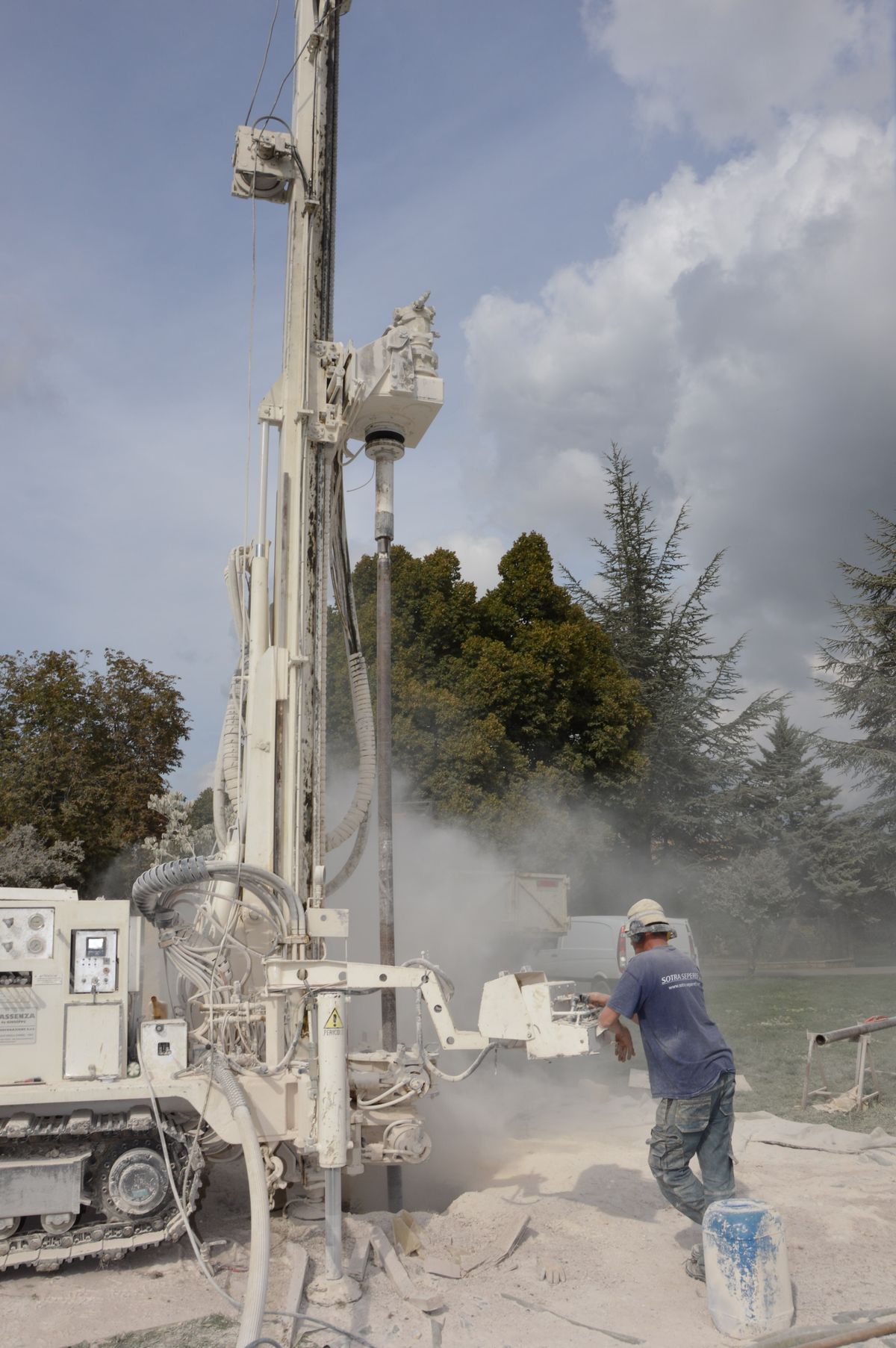
The Cradock area is underlain by classic Great Karoo geology — the Beaufort Group of the Karoo Supergroup, consisting of alternating mudstones and sandstones laid down in ancient floodplain and river environments hundreds of millions of years ago. These sedimentary layers are widespread, relatively flat-lying, and form the bedrock across the vast majority of the Karoo landscape.
Intruding into these sediments are extensive Jurassic-age dolerite bodies — sills (horizontal intrusions), dykes (vertical intrusions), and irregular irregular masses that have baked and hardened the surrounding Karoo mudstones. Dolerite is harder and more resistant to erosion than the sediments it intrudes, which is why it forms the cappings of the distinctive flat-topped hills and ridges that define the Karoo skyline around Cradock.
From a groundwater perspective, productive targets in this geology fall into two main categories. First, along the Great Fish River valley, younger alluvial sediments — gravels, sands, and silts deposited by the river over geological time — can hold shallower, more easily accessible groundwater. Second, and more broadly across the landscape, the fractured contacts between dolerite intrusions and the surrounding Karoo sediments are the primary drill targets: fractures that were opened when the hot dolerite cooled and contracted, or when overlying rock eroded and pressure was released, create permeable pathways that water moves through and accumulates in.
In Karoo geology, productive fracture zones are not uniformly distributed. A dolerite sill may run for kilometres with water-bearing fractures only at certain points along its contact with the surrounding sediments. The difference between a productive borehole and a marginal one can be a matter of tens of metres laterally. Drilling without a survey in this environment is an expensive gamble.
Everest Drilling's geophysical survey uses electrical resistivity methods to map subsurface geology from the surface. Dolerite, water-saturated fracture zones, and dry sediments all have different electrical resistivity signatures, allowing the survey to identify the most productive drill target at each specific site — where to drill, and at what orientation to intercept the most fractures.
Because the Karoo basin is deep and some geological targets require reaching significant depths, Everest Drilling's equipment is rated to drill to 250m. Borehole depth is always site-specific — a survey may identify a productive fracture at 60m, or the target may be considerably deeper. The survey determines the programme before any drilling begins.
Depth Guarantee
Everest Drilling guarantees the depth of the borehole as quoted and drilled. Once the survey has informed the drill programme and the depth has been agreed and quoted, that depth specification is guaranteed.
Everest Drilling provides end-to-end borehole services across Cradock, Inxuba Yethemba Local Municipality, and the surrounding Great Karoo — from initial geophysical survey through to running water at the tap or stock trough.
| Geophysical Survey | Resistivity survey to locate water-bearing fracture zones and identify the optimal drill target before any drilling commences. Site-specific assessment for every project. |
| Drilling Depth | Site-specific depth determined by survey results. Equipment rated to 250m. Everest Drilling guarantees the depth of the borehole as quoted and drilled. |
| Pump Installation | Submersible borehole pumps — grid-connected or solar-powered — sized to the borehole yield and the daily demand of the property or farm operation. |
| Solar Pump Systems | Full solar borehole pump systems: panels, controller, submersible pump, and cabling. Designed to fill an overhead storage tank through the day, supplying the property by gravity at all hours with no grid dependency. |
| Overhead Tanks | Elevated tank installation to provide gravity-fed supply and storage buffer — ensuring water availability around the clock, including during power outages. |
| Reticulation | Pipework from borehole to storage tank and from tank to the property, homestead, or livestock troughs. Municipal bypass valves available where dual supply is required. |
Everest Drilling services Cradock and the broader Inxuba Yethemba Local Municipality, including rural farms, game properties, and homesteads throughout the Great Karoo. We also cover nearby towns and districts in the Chris Hani District Municipality.
Residential and commercial properties, guesthouses, small businesses.
Livestock farms, game properties, irrigation farms along the Fish River.
Game lodges and concessions near Mountain Zebra National Park.
Middelburg (EC), Somerset East, Steynsburg, Hofmeyr, Komani.
Quotation
Contact Everest Drilling for a project-specific quotation. Every quote is based on a site survey and reflects the actual conditions at your property.
The Great Karoo presents a geological environment that rewards thorough preparation. Productive fracture zones in Beaufort Group sediments and dolerite intrusions are not distributed evenly — they concentrate at structural features that a geophysical survey can locate from the surface. Everest Drilling has extensive experience working in Karoo geology, understanding the relationship between dolerite intrusions, Karoo sediment contacts, and the water-bearing fracture zones that productive boreholes target.
Every borehole project Everest Drilling undertakes begins with a resistivity geophysical survey. The survey output guides the drill location, the drill orientation, and the target depth — eliminating the guesswork that leads to dry or low-yield holes. Once the drill programme is agreed and the depth quoted, that depth is guaranteed: Everest Drilling guarantees the depth of the borehole as quoted and drilled.
For farms and properties in the Cradock area — where the distance to town is long and the consequences of an inadequate water supply are serious — this survey-first, guaranteed-depth approach is the standard that every project deserves.
The water needs of the Cradock area are diverse — from large-scale sheep operations to game lodges, from irrigation farmers along the Fish River to rural homesteads and town properties.
Merino sheep farming is the backbone of the Karoo economy around Cradock. Adequate water supply directly affects flock condition, lambing rates, and weight gain. Cattle operations face similar pressures during hot, dry summers. A borehole fitted with a solar pump and overhead tank can supply a network of drinking troughs across a large farm, ensuring reliable access for every animal every day. On farms where boreholes already exist but yields are marginal, Everest Drilling's survey-informed approach identifies additional productive drilling targets.
The area around Cradock — including the Mountain Zebra National Park corridor — supports a growing game farming sector. Game properties require reliable water points distributed across their land for wildlife, and comfortable water supply at lodge facilities for guests. A solar borehole system is particularly well suited to remote game farm locations where grid infrastructure is limited and the premium is on reliability without high running costs. Everest Drilling can drill, pump, and reticulate water to multiple points across a game property.
The Great Fish River valley around Cradock supports productive irrigation farming — lucerne, vegetables, and other water-intensive crops that contribute significantly to the local agricultural economy. Irrigation operations require sustained, high-volume water access through growing seasons. Boreholes drilled into the alluvial groundwater of the Fish River corridor can provide productive supplementary supply, reducing dependence on river abstraction and providing a buffer during periods of low river flow.
Rural homesteads scattered across the Karoo — often far from the nearest municipal main — depend on boreholes as their primary water source. In town, Cradock's guesthouses, guest farms, and small businesses benefit from the security of an independent borehole that keeps supply stable regardless of municipal system pressures. A properly installed borehole with an overhead storage tank provides continuous supply with a solar or grid-connected pump, covering domestic use, gardens, and small-scale livestock around a homestead.
Survey-first borehole drilling for livestock farms, game properties, irrigation operations, and rural homesteads in Cradock and the Great Karoo. Contact Everest Drilling for a project-specific quotation.