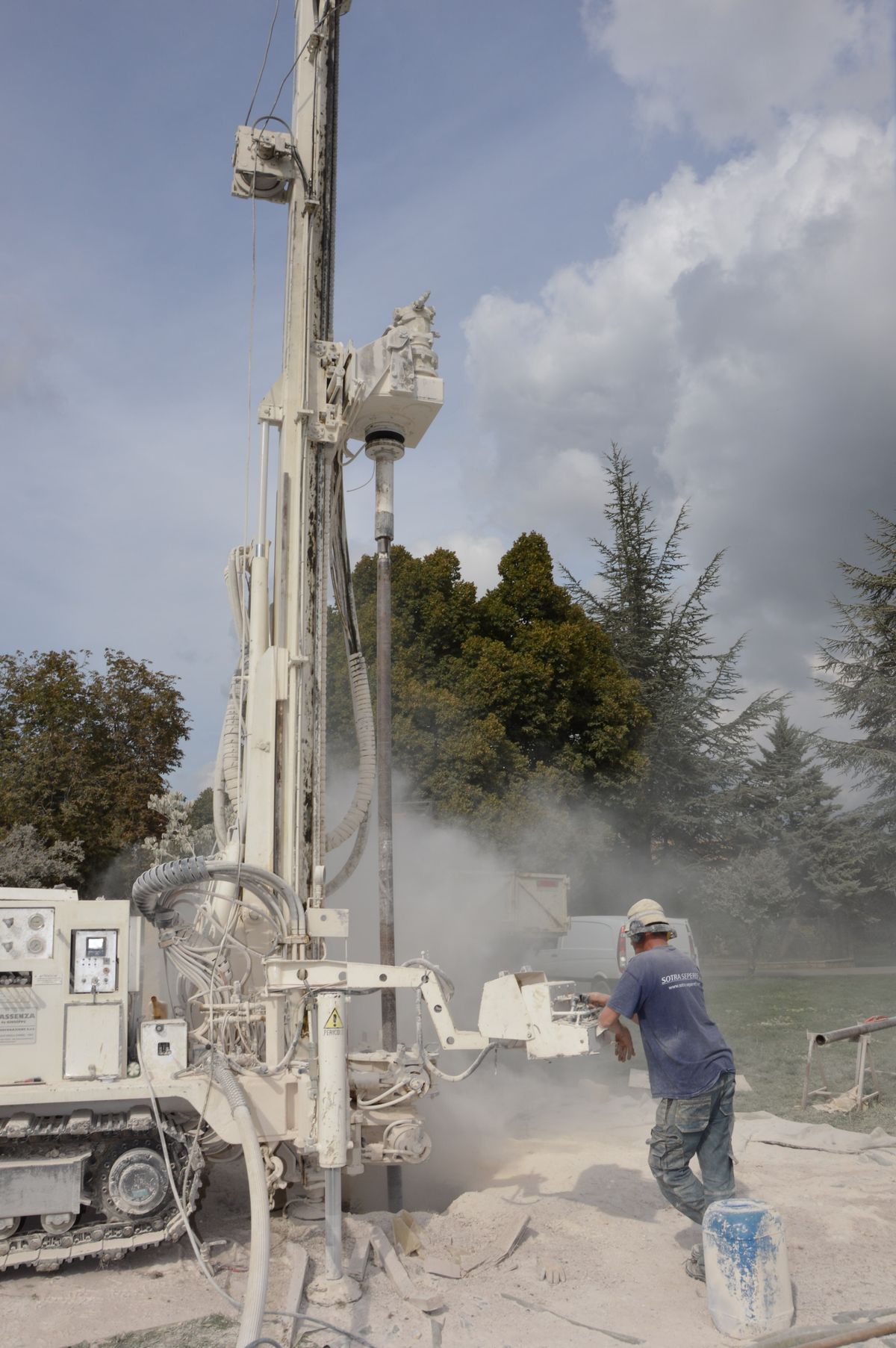
One of the most important — and most misunderstood — pieces of information produced after a borehole is drilled is the yield test result. Property owners frequently receive a figure such as "1 200 litres per hour" and have no frame of reference for what it means in practice: whether it's enough, whether it's good, or whether a different approach is needed.
This article explains exactly what a borehole yield test measures, how it is conducted, what the figures represent in real-world water terms, and what your options are if the yield is lower than hoped.
What Is a Borehole Yield Test?
A borehole yield test is a structured pumping trial carried out after a borehole has been drilled and developed. Its purpose is to determine the sustainable abstraction rate of the borehole — that is, how much water can be pumped from the borehole over time without causing the water level to drop so far that the pump runs dry or the aquifer is over-stressed.
It is important to understand what a yield test does not measure. It does not measure the total volume of water in the aquifer — aquifers are effectively infinite in extent relative to a single borehole. What it measures is the rate at which water flows into the borehole from the surrounding rock or sediment, and whether that rate can sustain continuous pumping at a given output.
The yield test also establishes two critical water level measurements: the static water level (the depth to water when the pump is at rest, which is the natural equilibrium level in the borehole), and the dynamic water level (the depth to water while the pump is running). The difference between these two levels, called the drawdown, is central to understanding the borehole's behaviour under load.
Without a properly conducted yield test, you cannot confidently select a pump, set a safe pump rate, or know whether the borehole will sustain your household or farm's water demand. Guessing — or simply installing the largest available pump — risks over-abstracting the borehole and reducing its long-term productivity.
How Yield Tests Are Conducted
There are two principal types of yield test used in South African borehole practice, and they serve complementary purposes.
The Step-Drawdown Test is typically the first test performed. The pump is run at successively increasing rates — usually three to five steps — and the water level response at each rate is recorded. Each pumping step is held for a fixed period (commonly 30 to 60 minutes per step), and the water level at the end of each step is noted once it has stabilised or reached a measurable steady state.
The step-drawdown test reveals how the borehole responds to increasing abstraction rates. At low rates, drawdown may be modest. As the pumping rate increases, drawdown increases — but the relationship is not always linear. In a well-connected, productive aquifer, doubling the pump rate may produce only a modest additional drawdown. In a restricted fracture system, doubling the rate might cause the water level to plunge rapidly. The step-drawdown test identifies the rate at which the borehole begins to show inefficiency — where additional pumping produces disproportionately large drawdown — and this "optimum yield" becomes the target for the constant rate test.
The Constant Rate Test takes the optimum rate identified in the step test and pumps at that fixed rate for a sustained period — typically between four and eight hours, though some applications require longer tests. Water level is monitored continuously throughout, and for a full hydrogeological analysis, an observation borehole nearby is also monitored to track how far the drawdown cone extends into the aquifer.
At the end of pumping, the pump is stopped and the borehole is allowed to recover. The rate at which the water level returns to its static level — the recovery curve — provides additional information about aquifer transmissivity and confirms whether the borehole is drawing from a genuinely productive zone or merely draining a limited fracture volume.
Both tests require calibrated flow meters and pressure transducers (electronic water level loggers) for accurate results. Manual dipping with a water level meter every few minutes is adequate for simpler assessments but introduces gaps in the data that can obscure aquifer behaviour.
What Yield Figures Actually Mean
Yield figures are almost always expressed in litres per hour (L/h) or, for larger boreholes, in cubic metres per hour (m³/h) or per day (m³/day). Converting between these is straightforward: 1 m³ = 1 000 litres, so a yield of 2 m³/h equals 2 000 L/h.
To put these figures in practical context:
- 200 L/h — 4 800 litres per day if pumped continuously. Marginal for a single household without storage accumulation, but usable with a large tank strategy.
- 500 L/h — 12 000 litres per day. Adequate for a medium household with moderate garden irrigation.
- 1 000 L/h (1 m³/h) — 24 000 litres per day. Comfortable for a large household, staff accommodation, or small-scale garden irrigation.
- 2 000–3 000 L/h — 48 000–72 000 litres per day. Suitable for small-scale agricultural use, game lodges, or light commercial operations.
- Above 5 000 L/h — Large agricultural or industrial applications; these yields are found in exceptionally productive aquifer zones.
Average household consumption in South Africa varies widely — from roughly 150 to 300 litres per person per day for domestic use, rising significantly when garden irrigation is included. A household of five people using 200 litres per person per day needs 1 000 litres daily for indoor use alone. Adding garden irrigation on a typical suburban plot can double or triple this figure on watering days.
Important: The yield figure from a test is the sustainable pumping rate, not the maximum possible abstraction. Running a pump above the tested yield will accelerate drawdown and risk running the pump dry, which causes pump damage and potentially destabilises the borehole. Always size your pump to operate at or below the tested yield.
Factors Affecting Borehole Yield in South Africa
South Africa's geology is enormously varied, and this variation drives significant differences in borehole yield potential across the country. Understanding the factors at play helps set realistic expectations before and after drilling.
Aquifer type is the primary determinant of yield. South African boreholes draw from two fundamentally different aquifer types:
- Fractured rock aquifers — found across the Karoo Supergroup, Witwatersrand formations, Cape Supergroup, and crystalline basement rocks. Water is stored in and moves through fractures, joints, and faults. Yield depends on how well-connected the fractures are and how many fractures the borehole intersects. A productive fracture zone can yield thousands of litres per hour; a borehole that misses major fractures may yield only a few hundred. This variability is why a geophysical survey is valuable before drilling — it identifies the structural targets most likely to carry water.
- Intergranular (porous) aquifers — found in alluvial deposits along river valleys, coastal sedimentary formations, and certain sand and gravel formations. Water moves through the spaces between grains rather than through fractures. These aquifers tend to be more predictable in yield but have their own depth and recharge constraints.
Depth affects yield in complex ways. Deeper boreholes intersect more rock and, in fractured systems, have more opportunity to encounter productive fractures. However, deeper fractures are not always more water-bearing — in many South African formations, the most productive fractures are found at intermediate depths rather than at the maximum depth of the borehole.
Seasonality has a significant effect on boreholes connected to unconfined aquifers with shallow water tables. After a dry winter in the Eastern Cape or KwaZulu-Natal, the static water level in many boreholes drops by several metres, and the sustainable yield may decrease accordingly. After summer rains and good aquifer recharge, static levels recover and yield improves. Confined aquifers under pressure are less affected by seasonal variation.
Local abstraction also plays a role. In areas with dense borehole installations — some peri-urban areas around East London, Port Elizabeth / Gqeberha, or Durban — neighbouring boreholes drawing from the same aquifer system can reduce available yield for all users over time if aggregate abstraction exceeds recharge rates.
What to Do If Borehole Yield Is Low
A low-yield borehole is not necessarily a failed borehole. There are several practical approaches to extracting useful water from a borehole that tests below the ideal rate for your demand.
The storage accumulation strategy is the most widely applicable. Instead of running a large pump intermittently to meet peak demand, you install a low-yield pump set to run continuously or on a long daily cycle, feeding into an overhead or underground storage tank. The tank accumulates the water over hours and provides it on demand when needed. A borehole yielding only 300 L/h delivers 7 200 litres over 24 hours — sufficient for a comfortable household if it flows into a 5 000-litre tank. The pump runs at a rate the aquifer can sustain; the tank handles the variable demand pattern.
Pump timer management takes this further. By programming the pump to run only during hours of peak solar output (for solar systems) or during off-peak Eskom periods, and allowing the borehole to recover water level during the rest of the day, the borehole's sustainable daily output can be maximised without stressing the aquifer.
Borehole rehabilitation is worth considering for boreholes that have declined in yield over time, or where development after drilling did not fully clear the fractures around the borehole. Airlift pumping — forcing air down the borehole to surge water up — can dislodge fine material that is blocking fracture entrances. In certain rock types, acid treatment can dissolve carbonate material clogging fractures. Hydro-fracturing (pumping water at high pressure into the borehole to extend existing fractures) can meaningfully increase yield in some fractured aquifer settings — though results vary by geology and cannot be guaranteed.
In cases where the geology is simply unfavourable and no technique improves the yield to a usable level, relocating the borehole to a more suitable position — informed by updated geophysical survey data — is the most reliable path forward. Everest Drilling can review the available geological and geophysical information to advise whether relocation is likely to improve outcomes.
How Borehole Yield Affects Pump Selection
The yield test result is the single most important input into pump sizing. A pump that operates above the borehole's sustainable yield will cause excessive drawdown — eventually dropping the water level below the pump intake, causing the pump to run dry. Dry-running damages the motor and can destroy the pump within minutes if the protection system does not trip in time.
The general principle is to select a pump whose maximum flow rate does not exceed the tested yield of the borehole. For a borehole with a tested yield of 800 L/h, a pump rated at 600–800 L/h at the total head required is appropriate. Going larger creates risk; going somewhat smaller is conservative and protective of the aquifer and the pump.
Beyond the flow rate, pump selection also depends on:
- Total dynamic head (TDH) — the sum of the vertical lift from the dynamic water level to the surface, plus friction losses in the rising main, plus any pressure required at delivery. A pump that delivers adequate flow at low head may be completely inadequate when the true TDH is calculated.
- Pump curve matching — every submersible pump has a performance curve showing flow rate versus head. The operating point where your system curve intersects the pump curve determines the actual flow delivered. Pump selection should be based on this analysis, not just on rated output at a single head figure.
- Borehole diameter and casing size — the pump body must fit inside the borehole casing with adequate clearance for the motor to be cooled by passing water. Standard 152 mm (6-inch) boreholes accept most 4-inch submersible pumps; smaller boreholes require purpose-built slim-line pumps with limited power options.
For solar-powered borehole systems, pump selection is further constrained by the available solar array output and the need to match the pump's operating window to peak solar hours. Everest Drilling's team handles the full pump selection process as part of a complete pump installation package, working from the yield test data to specify the correct pump, motor, solar array, and control panel for your specific borehole and demand profile.
Related Articles
Common Questions
Get Your Borehole Properly Yield-Tested
A yield test after drilling ensures your pump is sized correctly and your borehole is used sustainably. Contact Everest Drilling for a project-specific quotation.