🔬
Geophysical Survey
Pre-Drilling Ground Scanning
What it is: A geophysical survey is a non-invasive ground scanning method that uses electromagnetic (EM) induction and electrical resistivity measurements to map subsurface geology before any drilling begins. The equipment is surface-deployed — no holes are dug, no ground is disturbed.
How it works: Electrical current is transmitted through the ground and the response pattern is measured. Water-saturated fractured rock conducts electricity differently from dry solid rock. The survey software generates a subsurface profile showing the depth, lateral extent, and likely yield of underground water-bearing zones — allowing Everest Drilling's geologist to select the optimal drill point with high confidence.
South Africa context: South Africa's geology is highly variable — Karoo sandstone, Witwatersrand granite, Cape sandstone, KZN basement complex, and coastal sediments all require different interpretations. Everest Drilling's geophysicists have calibrated survey interpretation for all major South African geological regions.
Key benefit:
Helps reduce the risk of drilling an unproductive borehole by mapping subsurface water-bearing formations before any drilling begins.
🏗️
Water Borehole Drilling
Up to 250 Metres · Soft & Hard Formation
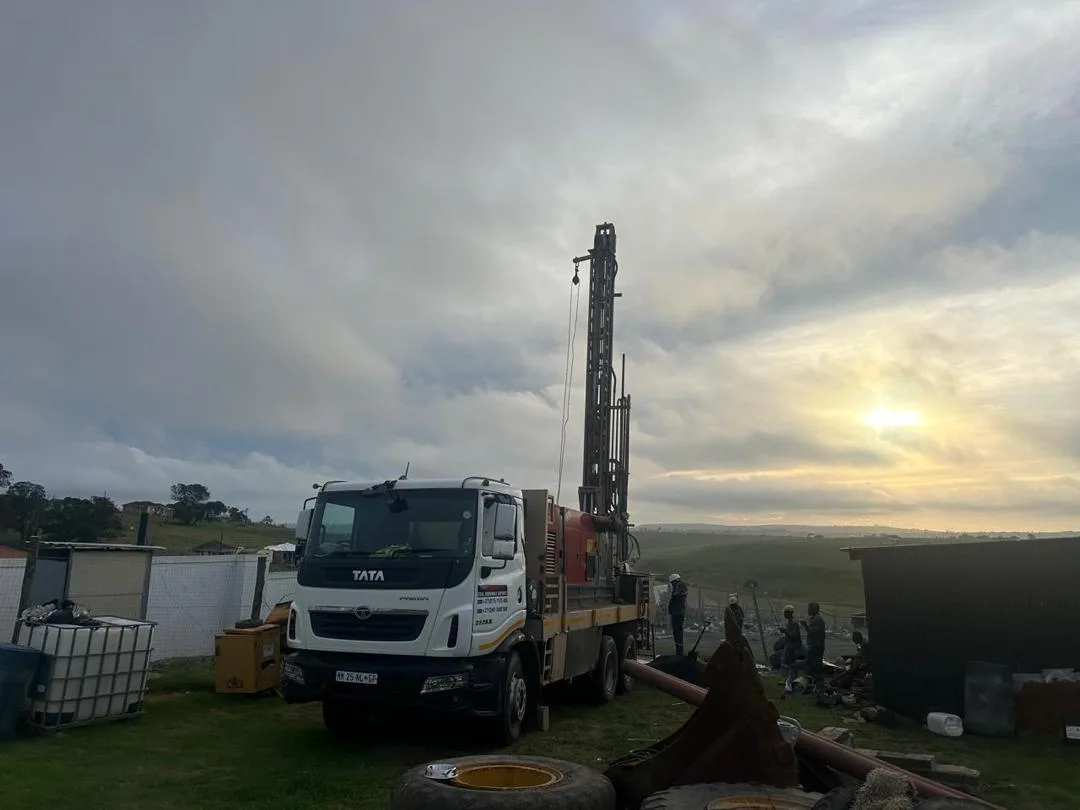
What it is: Water borehole drilling is the mechanical process of boring a narrow, precise vertical shaft through soil, rock, and geological formations to reach underground water-bearing aquifers. Everest Drilling uses heavy-duty truck-mounted rigs capable of drilling to 250 metres in any South African geological formation.
How it works: The drill string rotates under high torque while hydraulic percussion breaks through hard formations. Water or air is circulated to cool the bit and flush cuttings to surface. As each metre is drilled, cuttings are logged by the driller to track formation changes and identify water strikes. Casing is installed during or immediately after drilling to prevent wall collapse.
South Africa context: Drill diameter is 6.5" continuous for standard water boreholes, with 9", 10", and 12" overburden options for unconsolidated surface layers. Drilling duration depends on site-specific conditions including formation hardness, depth, and access.
Cost guide:
Project requirements vary based on site conditions, geology, access requirements, equipment requirements, and project scope. Please contact Everest directly for a project-specific quotation.
Free Quotation — No Obligation
Ready to get started? Request a written quote.
Tell us your location, project type, and water needs — we'll send you a full cost breakdown. Free, fast, no commitment.
🪨
Sedimentary Drilling
Karoo Basin · Eastern Cape · Free State Specialist
What it is: Sedimentary drilling targets water stored in the pore spaces and fractures of sedimentary rock sequences — particularly the Karoo Supergroup formation which underlies approximately 60% of South Africa's land area. These formations include mudstone, shale, sandstone, and occasional dolerite intrusions.
How it works: Sedimentary formations require different bit configurations and drilling parameters compared to hard crystalline rock. Karoo sandstone is relatively soft and drills quickly, but dolerite sills and dykes — common intrusions throughout the Karoo — are extremely hard and require percussion hammer techniques. Everest Drilling's rig is configured for mixed-formation drilling, switching methods as geology demands.
South Africa context: The Karoo Basin is South Africa's most important agricultural groundwater region. Eastern Cape, Northern Cape, Free State, and Mpumalanga all have significant Karoo sedimentary groundwater resources. Borehole depth varies based on site-specific geological conditions. Please contact Everest for project-specific guidance.
Regional advantage:
Eastern Cape is Everest Drilling's regional headquarters — our team has the deepest knowledge of local Karoo and coastal sedimentary geology of any drilling contractor in the province.
⚙️
Pump Installation
Submersible & Hand Pump · Pressure Tested · Warranted
What it is: Pump installation is the supply, installation, commissioning, and testing of the water extraction system that lifts water from the borehole aquifer to the surface distribution network. Everest Drilling installs both submersible pump sets (for boreholes deeper than 10m) and hand pumps (for rural and off-grid applications).
How it works: The pump is selected based on borehole yield, depth, required surface pressure, and power supply. A stainless-steel rising main connects the pump to the surface wellhead. Electrical cables are secured to the rising main. The pump is lowered to the correct depth, connected to the control panel, and the system is commissioned and tested. Where applicable, warranty is provided by the product manufacturer according to the manufacturer's terms and conditions.
Load-shedding resilience: Everest Drilling advises all clients on load-shedding resilience strategies — including correctly sized overhead storage tanks (12+ hours reserve), backup generator connections, solar-powered pump systems, and variable-frequency drives for solar/battery compatibility.
What's included:
Pump supply, rising main, wellhead fittings, control panel, electrical connection, system commissioning. Where applicable, warranty is provided by the product manufacturer according to the manufacturer's terms and conditions.
Turnkey Water Solution
Survey → Borehole → Pump → Tank. One call covers it all.
Our turnkey package covers the full scope under one contractor — no juggling multiple service providers.
✓Quality Tank Construction
✓Professional Installation
🏗️
Overhead Tank Construction
Residential · Agricultural · Industrial
What it is: Overhead water tank construction involves building an elevated water storage structure that uses gravity to deliver water pressure to the distribution system — eliminating the need for a constant-pressure pump on the supply side. Everest Drilling constructs elevated tanks with full structural design, foundation, and installation.
How it works: A reinforced steel or concrete support structure is erected to the required height (typically 3–8 metres above the highest distribution point). A polyethylene tank (2,000–30,000 litres) is mounted on the structure. Pipework connects the borehole pump to the tank (fill line) and the tank to the distribution network (outlet). Float valves or level controllers prevent overflow.
Load-shedding benefit: An overhead tank stores water to maintain supply during load-shedding and power outages, providing a buffer when the borehole pump cannot run. Tank capacity should be matched to your household or commercial usage requirements.
Construction standards:
All Everest Drilling tank structures include structural load calculations, foundation design, and appropriate tank material selection for the intended use.
💧
Full Turnkey Water Supply
End-to-End · One Contractor · One Point of Contact
What it is: A full turnkey water supply project means Everest Drilling handles every step — from initial geophysical survey and borehole drilling through to pump installation, overhead tank construction, pipework, commissioning, and client handover. One contractor, single point of responsibility, no subcontracting.
The 5-step process:
1. Geophysical survey → optimal drill point identified.
2. Borehole drilling → rig mobilised, shaft drilled to water-bearing zone.
3. Casing and development → casing installed, borehole cleaned and developed.
4. Pump and tank installation → pump set, rising main, overhead tank, and pipework completed.
5. System commissioning → system fully tested and commissioned.
Typical timeline:
Project timelines vary depending on scope, access, geology, and site conditions. Contact us for a project-specific timeline estimate.