Graaff-Reinet is one of South Africa's oldest towns, nestled in the Sundays River Valley deep in the Great Karoo. It is the principal centre of the Dr Beyers Naudé Local Municipality within the Sarah Baartman District. The surrounding landscape is classic semi-arid Karoo — wide open plains, dramatic dolerite outcrops, and the iconic Valley of Desolation in the Camdeboo National Park looming to the west of town.
In this environment, surface water is scarce. Rainfall averages around 300mm per year, rivers run intermittently, and reticulated municipal water reaches little beyond the town itself. For the vast majority of properties across this region — sheep farms, goat and cattle operations, game reserves, hunting lodges, eco-tourism guest farms, and rural homesteads — groundwater accessed through a borehole is the primary and often only reliable water source.
Finding and developing that groundwater takes expertise. The Karoo's complex geology — ancient sedimentary rock cut through by harder dolerite intrusions — means that groundwater moves and accumulates very differently from coastal or wetter regions. A geophysical survey before drilling is not merely advisable here; it is the essential foundation of any successful borehole project in the Great Karoo.
Ready to Start?
Discuss your Graaff-Reinet borehole project with our team. We'll advise on survey requirements, depth expectations, and pump options for your site.
+27 (0) 75 112 3456 →The bedrock beneath Graaff-Reinet and most of the surrounding Great Karoo belongs to the Beaufort Group — a thick sequence of mudstones and sandstones deposited in ancient river systems during the Permian and Triassic periods. These sedimentary rocks form the platform of the Karoo Supergroup and extend across hundreds of kilometres of the interior plateau. In their undisturbed state, Beaufort Group rocks have very low primary porosity and permeability — they do not store or transmit groundwater in the way that sands or gravels do. The groundwater that does exist is held in secondary fractures: cracks, joints, and fissures that have opened over geological time through tectonic stress and the intrusion of younger rocks.
During the Jurassic period, hot magma intruded into the Karoo Supergroup sediments as sills (horizontal sheets) and dykes (vertical walls), cooling to form hard dolerite rock. These dolerite bodies are the geological structures responsible for features like the Valley of Desolation near Graaff-Reinet — those dramatic columns of dark rock rising from the landscape are the eroded remnants of ancient dolerite intrusions. What makes dolerite critically important for borehole drilling is what happens at the contacts between dolerite and the surrounding sedimentary mudstones and sandstones. The heat and pressure of the intrusion thermally altered the adjacent rock, creating aureoles of fractured and altered material. These contact zones — and the network of fractures that radiate from them — are where groundwater preferentially accumulates and moves. Targeting a drill point in relation to known or suspected dolerite intrusions, using geophysical methods, dramatically improves the probability of striking a productive water-bearing fracture.
In the immediate vicinity of the Sundays River, which flows through Graaff-Reinet itself, alluvial sediments deposited along the river valley can host a shallower, more accessible groundwater resource. These alluvial aquifers are typically less complex to develop than deep fractured-rock targets and may support smaller domestic or garden supplies. However, yields are generally more modest and the extent of the alluvial aquifer is limited to the river corridor. For farms on the wider Karoo plains, or for any application requiring a robust and sustained yield, the deep fractured-rock aquifers in the Beaufort Group and dolerite system remain the primary target — and a geophysical survey is the only reliable way to locate productive drill positions within that system.
In wetter, more geologically uniform environments, experienced drillers can sometimes select a drill point based on observation alone. In the Great Karoo, this approach carries a high risk of failure. The fracture zones that carry groundwater are narrow, discontinuous, and deeply buried beneath apparently featureless terrain. Two boreholes drilled 50 metres apart — one positioned by survey and one positioned by intuition — can produce dramatically different results. Everest Drilling's survey-first approach uses electromagnetic geophysical methods to map subsurface resistivity contrasts, identifying anomalies that indicate fracturing and moisture at depth. This survey data, combined with our understanding of Karoo geology, guides the selection of an optimal drill point and a depth estimate for your specific site. The survey is the single most cost-effective investment in the success of any Karoo borehole project.
Everest Drilling's team understands the particular demands of drilling in the Great Karoo — the hard, competent dolerite rock that must be penetrated to reach fracture zones; the depth variability that can take a productive fracture anywhere from 40m to over 150m below surface; and the need for correct borehole construction to protect casing in thermally altered zones near dolerite contacts. We operate heavy-duty rigs capable of handling the conditions and depths that Karoo groundwater exploration requires.
We do not drill blind. Every Karoo project begins with a geophysical survey — the only defensible way to select a drill point in fractured-rock Karoo geology.
Everest Drilling guarantees the depth of the borehole as quoted and drilled. You will receive exactly the metres of hole agreed in your project quote.
From survey through to pump commissioning and tank construction — one contractor, one project, one point of responsibility.
Complete end-to-end groundwater solutions for the Great Karoo — from geophysical survey through to solar pump installation and elevated storage tanks for farms, game lodges, guest accommodation, and rural homes.
Electromagnetic survey to map subsurface resistivity and identify fracture zones in the Beaufort Group and dolerite contact areas — the essential first step for every Karoo borehole project.
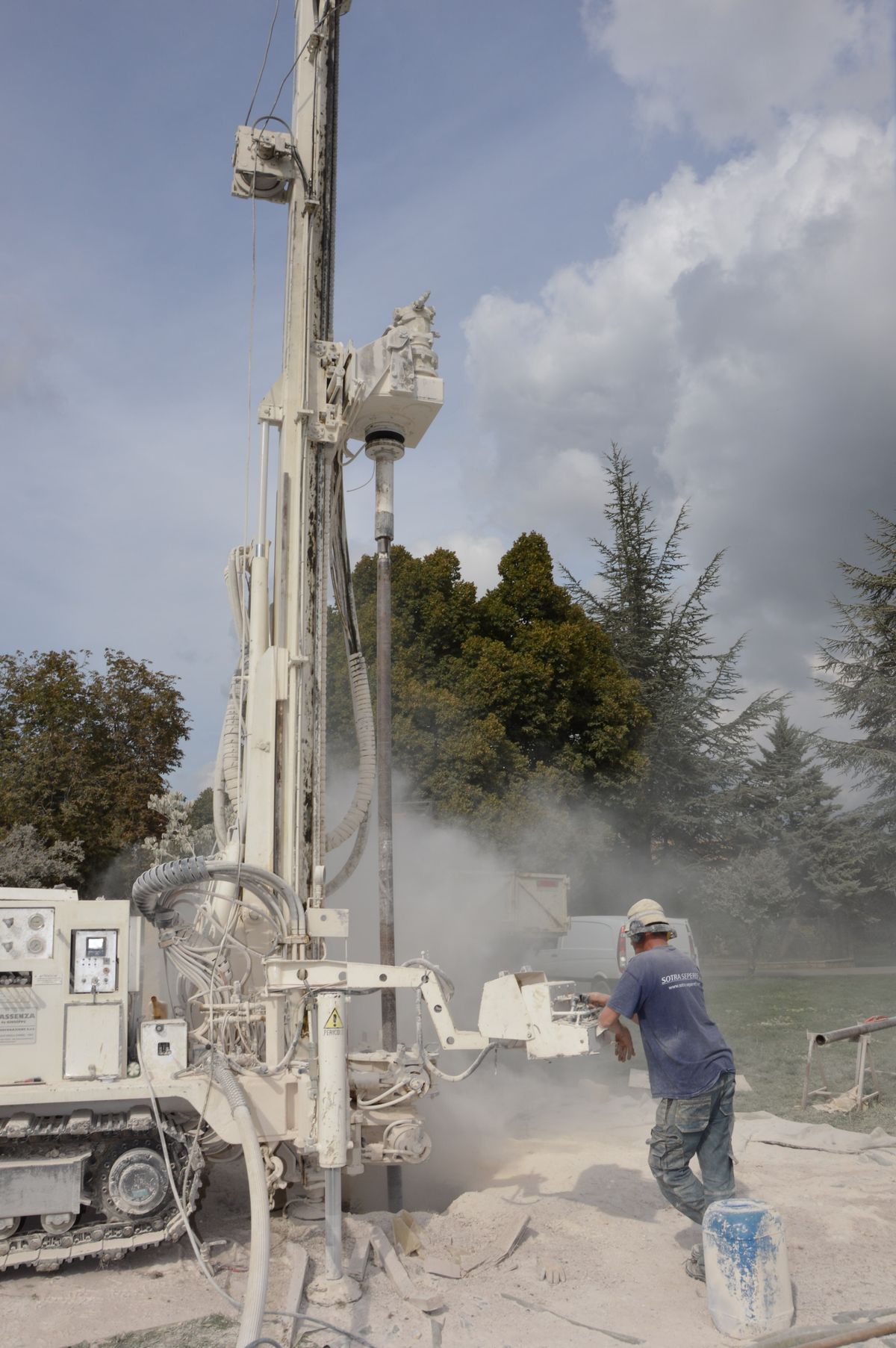
Professional drilling to 250m in the hard Karoo rock formations. We drill through both the softer mudstones and the competent dolerite intrusions to reach productive fracture zones at depth.
Supply and installation of submersible pump sets sized to your borehole yield and daily water demand — livestock farms, domestic supply, and guest lodge applications all require different pump configurations.
Solar-powered borehole pumps are ideal for the Great Karoo — high sunshine hours, remote farm locations far from Eskom infrastructure, and the need for load-shedding-proof water supply all make solar the practical choice.
Elevated storage tanks provide gravity-fed water supply to all points on the property — homesteads, livestock troughs, guest rooms, and worker facilities — without the pump running continuously.
Survey → drill → casing → pump → solar → tank → commission. One contractor manages the complete project — one contract, one team, one handover when water reaches your tap.
In a semi-arid environment where rainfall is unreliable and municipal reticulation is limited to town boundaries, a private borehole is the foundation of reliable water supply for almost every property type in the Graaff-Reinet district.
Merino sheep, Angora goats, and cattle operations across the Graaff-Reinet district all require reliable water at multiple points across often-large properties. A borehole with a solar pump and reticulated distribution to field troughs gives farmers water security regardless of rainfall or municipal supply availability. For large farms requiring multiple water points, a multi-borehole strategy may be needed — the geophysical survey identifies the best drilling targets across the property.
The Graaff-Reinet area supports a significant game farming and hunting lodge sector. Game water points distributed across the reserve are essential for keeping animals on the property and creating wildlife viewing opportunities. Solar boreholes supplying remote troughs — often far from any power line — are an Everest Drilling specialty. A turnkey solar borehole feeding an elevated tank that gravity-fills distributed concrete troughs can serve an entire game section with minimal ongoing attention or operating cost.
Graaff-Reinet and the surrounding Karoo are increasingly popular as eco-tourism, birding, and stargazing destinations. Guest farms, B&Bs, and self-catering cottages on rural properties require consistent water for ablutions, kitchens, gardens, and pool top-up. Intermittent municipal supply is unsuitable for a hospitality operation — a reliable borehole with appropriate pump capacity and elevated storage provides the consistent pressure and volume that guests expect.
Rural homes, smallholdings, and off-grid retreats throughout the Dr Beyers Naudé LM — whether around Nieu-Bethesda, Aberdeen, Pearston, Jansenville, or in the open Karoo between towns — often have no practical alternative to a private borehole for domestic water. A well-designed borehole, solar pump, and overhead storage tank provides a permanent, independent water supply that functions entirely without municipal infrastructure or regular Eskom supply.
Serving Graaff-Reinet and the broader Dr Beyers Naudé LM including surrounding towns and the open Karoo farming districts.
Don't see your area listed? Contact us — we cover properties throughout the Sarah Baartman District and the wider Great Karoo.
Start Your Karoo Borehole Project
Contact us to discuss your Graaff-Reinet borehole project. We will advise on survey requirements, what to expect from Karoo geology at your specific site, and provide a project-specific quotation — no generic pricing, every Karoo project is different.
Related Reading