A borehole project is not simply a matter of arriving on site and drilling a hole. Every professional borehole installation follows a structured sequence of steps — each one building on the last — to give the finished borehole the best possible foundation for long-term performance. Understanding this process helps property owners know what to expect, what questions to ask, and why each stage exists.
This guide walks through every stage of how Everest Drilling approaches a borehole project, from the initial site assessment through to commissioning.
Step 1 — Geophysical Survey and Site Assessment
No professional borehole project should begin without a geophysical survey. This is the single most important pre-drilling step — and the one most commonly skipped by less experienced contractors.
A geophysical survey uses electromagnetic scanning technology to map the rock formations beneath your property. Groundwater in South Africa is stored in fractures, joints, and fault zones within the underlying rock. These fractures are not uniformly distributed — they occur in specific locations that can be identified from surface before any drilling begins.
The survey identifies the optimal drilling location on your property: the point where productive water-bearing fractures are most likely to be intersected. Drilling on a surveyed location significantly reduces the risk of a dry or low-yielding borehole.
Why this step matters: Drilling without a geophysical survey is like building a house without checking the ground conditions. The survey takes a few hours and is the most cost-effective risk-reduction step in the entire project.
Step 2 — Site Preparation and Rig Mobilisation
Once the optimal drilling location has been identified, the site is prepared for the arrival of the drilling rig. Site preparation involves:
- Confirming vehicle access routes to the drilling location
- Identifying underground services (electrical cables, pipes) near the drill point
- Arranging a water supply for the drilling process — drilling requires water for dust suppression and bit cooling
- Clearing any surface obstacles around the drill point
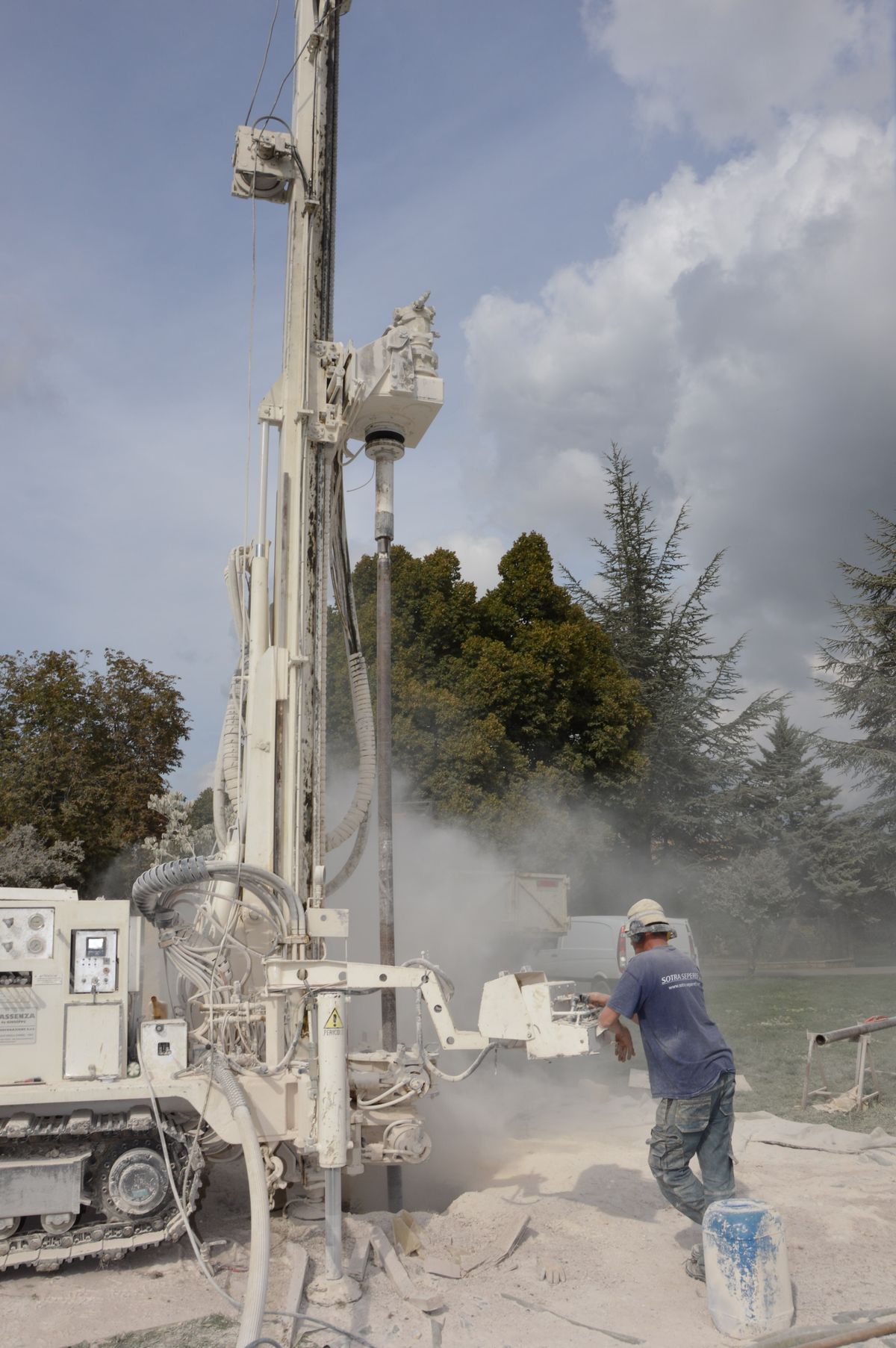
Everest Drilling operates industrial-grade rotary percussion rigs capable of accessing most residential, commercial, and agricultural sites. The rig is mobilised to site and positioned over the marked drill point. Equipment checks are completed before drilling begins.
Step 3 — Rotary Percussion Drilling
With the rig positioned and checked, drilling begins. Everest Drilling uses the rotary percussion method — a combination of rotation and high-impact percussion that efficiently penetrates the hard rock formations common across South Africa.
The drill bit rotates while simultaneously hammering downward, breaking rock and advancing the borehole. As the bit descends, drill cuttings (ground rock fragments) are flushed to the surface by compressed air. These cuttings are monitored throughout the drilling process — changes in colour, texture, and moisture content indicate changes in the rock formation below and signal when water-bearing zones are being encountered.
Drilling continues until the target depth is reached or productive water-bearing fractures have been intersected. Our rigs are rated to a maximum depth of 250m — sufficient for any South African formation.
Step 4 — Borehole Casing Installation
Once drilling is complete, steel or PVC casing is installed in the upper section of the borehole. Casing serves several critical functions:
- Prevents the borehole walls from collapsing in unconsolidated or weathered rock near the surface
- Seals out surface water, soil, and contaminants from entering the borehole
- Provides a clean, protected conduit through which the pump is later installed
The casing is grouted (sealed) at the surface to prevent ingress of surface runoff. A borehole with properly installed and sealed casing is protected from surface contamination and maintains its structural integrity over many years.
Step 5 — Pump Selection and Installation
With the borehole cased and sealed, the pump system is selected and installed. The appropriate pump type and specification depends on the borehole depth, the intended application (domestic, agricultural, commercial), and the required delivery flow rate.
Everest Drilling supplies and installs both submersible pump sets and hand pumps. A submersible pump is lowered into the borehole on a rising main and operates fully submerged below the water level. It delivers water to the surface under pressure, feeding directly to storage tanks, irrigation systems, or the property's water distribution network.
The pump is connected to a control panel at the surface that manages operation, protects against dry-running, and provides the interface for the property owner to control the system. All pump installations are commissioned and tested.
Step 6 — Water Storage (Where Required)
Many borehole projects include an overhead water tank as part of the full turnkey installation. An elevated storage tank allows gravity to maintain water pressure throughout the property — eliminating the need for a continuously running pump and providing a reserve buffer against pump downtime.
Elevated tanks are constructed on steel stands at a height calculated to deliver adequate pressure to all outlets on the property. Tank capacity is determined by the property's daily water demand and the pump's flow rate.
Step 7 — System Commissioning
The final stage of every Everest Drilling project is commissioning — a systematic test of the complete installed system before the project is complete.
Commissioning includes:
- Running the pump and confirming delivery to all intended outlets
- Checking control panel operation and protection settings
- Confirming tank fill and gravity delivery (where applicable)
- Explaining the operation and basic maintenance of the system to the property owner
- Providing documentation for the installation
A correctly commissioned borehole system should operate reliably from day one. Everest Drilling does not leave a site until the client understands how to operate their system and is satisfied with the installation.
How Long Does a Borehole Project Take?
Total project duration depends on site conditions, depth drilled, tank construction requirements, and rig scheduling. A straightforward residential project — survey, drilling, pump installation, no tank — can often be completed within two to three working days on site. Larger commercial or agricultural installations with tank construction require additional time.
Everest Drilling will provide a realistic project timeline as part of your site assessment and quotation.
What to Ask Your Borehole Contractor
Before appointing any borehole contractor, the following questions help establish whether they follow a professional process:
- Do you conduct a geophysical survey before drilling?
- What drilling method and equipment do you use?
- Do you supply and install the pump, or is that sub-contracted?
- Do you commission the completed system before handover?
- Do you provide documentation for the installation?
A contractor who follows the full process described above — survey, drilling, casing, pump, commissioning — provides far greater assurance of a successful outcome than one who offers only drilling as an isolated service.
Related Articles
Common Questions
Ready to Start Your Borehole Project?
Contact Everest Drilling for a free site assessment. We follow every step in this guide — survey first, always.