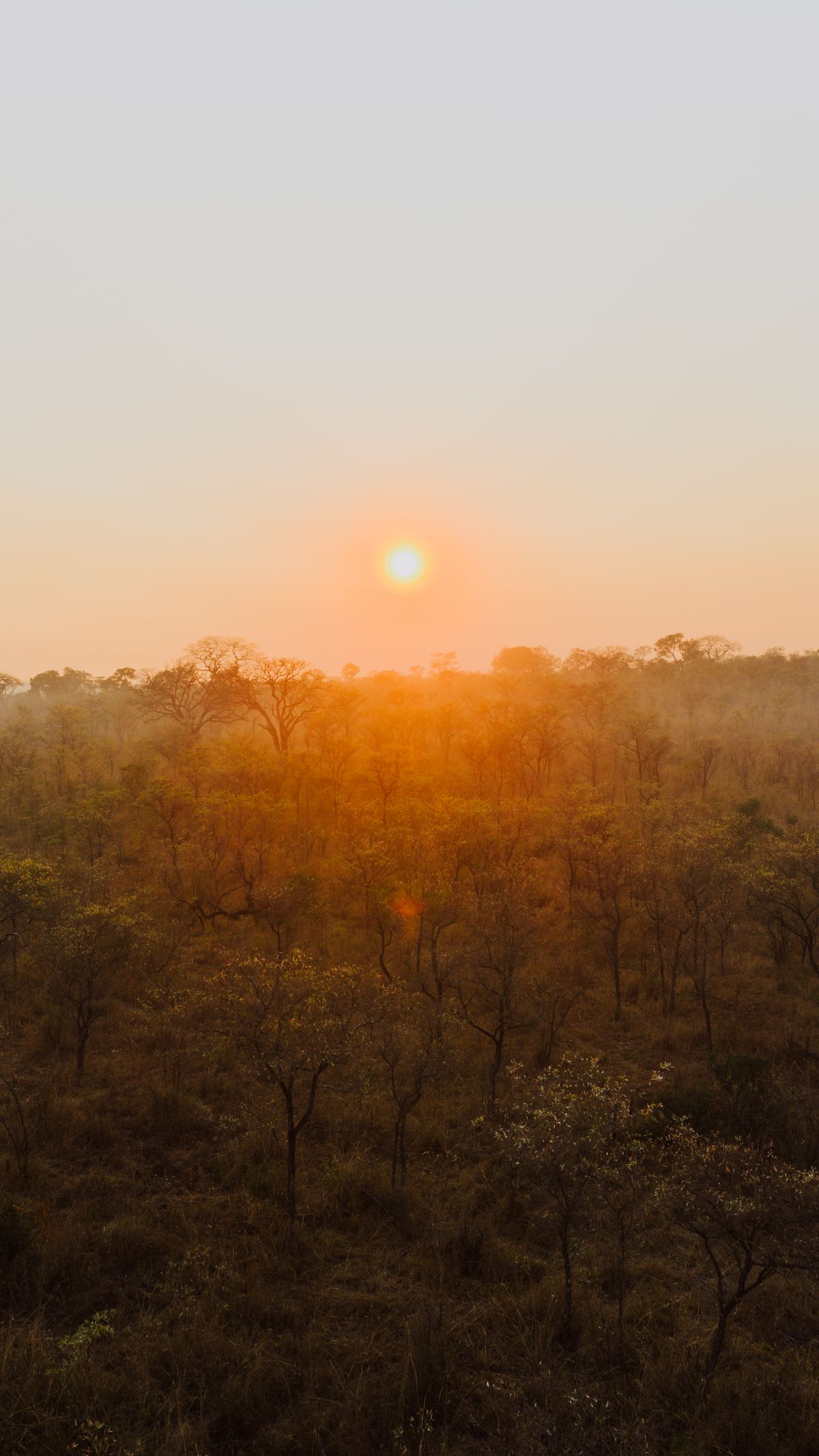
Water is the single most critical resource on any game farm or wildlife reserve. It determines where animals move, how land can be divided into camps, whether bush camp guests can be accommodated in comfort, and how staff quarters and ablution facilities operate year-round. Unlike a crop farm with predictable, season-bound water demand, a game property needs water continuously — for animals that drink daily, for permanent human occupation, and for the ecological health of the land itself.
For the vast majority of South African game farms, boreholes are the only practical answer. This article looks at the water demands of game properties in detail, why municipal supply cannot serve them, how to approach siting and drilling across a large footprint, and how solar pump systems and gravity reticulation make remote water points a reality without Eskom infrastructure.
The Water Needs of a Game Farm
Water demand on a game farm or wildlife reserve is multi-layered and must be planned for in full before any borehole strategy can be developed. The key categories of demand are:
Animal drinking water. Game animals drink daily, and their water requirements vary substantially by species, season, and body size. Browsers like kudu and impala are more drought-tolerant than grazers like buffalo, wildebeest, and zebra, but all require access to reliable drinking points throughout the year. In summer, water demand per animal increases significantly as temperatures rise. The spacing and capacity of drinking troughs or natural water points determines the stocking density the land can support.
Camp water points. Where the property is divided into electrified game camps or rotational grazing camps, each camp typically requires at least one water point. These can be troughs fed by a pump-to-trough system, a tank-and-gravity system, or a natural dam maintained at level by a borehole feed. The number of camps directly translates to the minimum number of water supply points the system must maintain.
Dams and artificial water features. Many game farms maintain one or more dams for hippo, crocodile, waterbirds, and as drinking points for large herds. While dams may be filled partly by rainfall runoff, a borehole can be used to top up a dam during dry periods and prevent it from dropping to critically low levels during drought. This is particularly important on game lodges where the waterhole is a focal point for game viewing.
Ablution blocks and guest accommodation. A game lodge or tented bush camp has the same water demands as any other tourism accommodation — showers, toilets, kitchen, laundry. These facilities typically require a reliable pressurised supply, which is usually provided by a dedicated borehole and pump feeding an elevated storage tank and pressure system.
Staff quarters and farmstead. Permanent staff living on the property need a reliable domestic water supply for their housing, ablution facilities, and any vegetable gardens or small livestock. This can be supplied from the main borehole system or from a dedicated shallow domestic borehole depending on the layout of the property.
Why Municipal Supply Is Impractical on Large Game Properties
The impracticality of municipal water supply for game farms is almost self-evident, but it is worth articulating clearly for property owners who are evaluating their options. There are several compounding reasons why municipal water is not a viable primary source for game farm water supply.
Geographic isolation. Most South African game farms are located in rural areas where municipal water infrastructure simply does not extend to the farm boundary. The capital cost of extending municipal supply pipelines across kilometres of farmland would be enormous, and in most cases no municipal authority has any obligation or intention to do so.
Distribution across large footprints. Even if municipal supply were available at the farm gate, distributing it across a property of several hundred or several thousand hectares to supply multiple drinking points would require an extensive pump-and-pipe reticulation network. This is essentially the same infrastructure a borehole-based system would require — except it would remain permanently dependent on the municipal tariff and the performance of the municipal supply.
Reliability and load shedding. Municipal water supply depends on electric pump stations at treatment works and distribution reservoirs. During load shedding or infrastructure failure, municipal supply is disrupted. For a game farm, a disruption of even 24 hours in hot summer conditions can put animals under severe stress. Self-reliant borehole supply with solar or battery backup eliminates this dependency entirely.
Cost at scale. At the volumes required to water game across several hundred hectares, municipal water tariffs represent a recurring and escalating operational cost that can be eliminated by borehole supply. Groundwater from a borehole has no ongoing per-litre tariff — once the infrastructure is in place, the water itself is free.
Siting a Borehole on a Large Game Farm: Why a Geophysical Survey Is Essential
On a small residential stand, a borehole can sometimes be positioned based on local knowledge or near-neighbour experience. On a game farm of several hundred or several thousand hectares, this approach is inadequate — and expensive mistakes are made when a drill rig is positioned by guesswork on a large property and drilled to depth without finding productive water.
A geophysical survey maps subsurface features — fracture zones, fault lines, dolerite intrusions, lithological contacts — using electrical resistivity, electromagnetic, or seismic methods applied at surface. These features are the targets for groundwater in the fractured rock aquifers that dominate the Eastern Cape, Karoo, and KwaZulu-Natal game farm areas. The survey identifies where subsurface fractures occur and gives the driller a target zone with a probability-weighted depth estimate.
On a large property, the geophysical survey does more than identify a single drilling target — it maps the property to identify multiple viable locations, which is critical for a multi-borehole water supply strategy. The survey output allows the water supply planner to position boreholes where the geology is most favourable and where the proposed water points on the property map align with accessible groundwater.
Without a geophysical survey, boreholes on large properties are often positioned based on practical access considerations — near a road, near existing infrastructure — without regard for whether the geology at that point is productive. This can result in dry or low-yield holes that must be abandoned and redrilled elsewhere. The cost of a geophysical survey is consistently lower than the cost of a failed or low-yield borehole.
Multi-Borehole Strategy for Large Game Farms
A single borehole, however productive, cannot realistically supply water to every corner of a large game farm without prohibitively long and expensive pipelines. The practical approach for properties above a few hundred hectares is a distributed multi-borehole strategy: multiple boreholes positioned across the property, each serving the water demand of its surrounding area, minimising pipe run distances and eliminating single points of failure.
The advantages of a multi-borehole approach are significant:
- Redundancy. If one borehole requires pump maintenance or experiences a temporary yield drop during drought, the other boreholes on the property continue to supply their respective areas. Animals are never entirely without water.
- Reduced pipe infrastructure. Short pipe runs from a borehole to its nearest water points are far more cost-effective than a single long reticulation main running across the property. Less pipe means less installation cost, less maintenance, and fewer opportunities for leaks and failures.
- Distributed aquifer draw-down. Multiple boreholes spaced appropriately across the property each draw from a different part of the aquifer system, rather than concentrating depletion around a single point. This distributes the pumping stress across the groundwater system and reduces the risk of localised aquifer depletion during high-demand periods.
- Flexibility for phased development. New boreholes can be added as the property develops — as new camps are opened, as guest accommodation is expanded, or as stocking densities increase. Each borehole is planned and drilled as a discrete unit rather than requiring a wholesale redesign of the water supply system.
Everest Drilling's Eastern Cape base positions the team well for multi-rig deployment across large game properties. Contact for a project-specific quotation covering survey, drilling, and pump installation across multiple positions on a single property.
Solar Pump Systems for Remote Boreholes: No Eskom Required
The defining challenge of water supply on a game farm is that many of the locations where water is needed most — in the middle of a large camp, at a remote waterhole, or at a lookout point far from the farmstead — have no connection to the Eskom grid. Running powerlines to every remote borehole position across a large game property is expensive, visually intrusive, and exposes the system to the same load-shedding vulnerability that makes grid power unreliable for this application.
Solar pump systems solve this completely. A solar-powered borehole installation for a game farm drinking trough or remote camp water point consists of:
- Solar panels mounted on a ground-frame or elevated structure near the borehole. Panel array size is matched to the pump power requirement and the daily pumping hours needed to fill the storage tank.
- Solar pump controller (also called a Variable Frequency Drive or VFD) that converts the DC output from the solar panels to the AC frequency required by the submersible pump, modulates pump speed to match available solar power throughout the day, and provides dry-run and overload protection.
- Submersible borehole pump sized to the borehole yield and the required fill rate for the storage tank, operating during daylight hours when solar power is available.
- Elevated storage tank into which the pump fills water during the day. The tank is sized to hold at least one to two days' demand — providing continuous water supply even on cloudy days or during nights when the pump is not running.
Solar pump systems for game farms are typically designed to pump throughout the day and fill the tank, which then drains continuously to the drinking trough or water point by gravity. The system is fully autonomous — no grid, no generator, no fuel. The only routine maintenance required is periodic cleaning of the solar panels and inspection of the float valve at the storage tank.
No Eskom? No problem. Everest Drilling supplies and installs turnkey solar borehole pump systems for remote game farm water points — from geophysical survey through to the completed solar array, pump, controller, and storage tank. Contact for a project-specific quotation.
Overhead Tank and Gravity Reticulation for Game Drinking Points
Gravity reticulation is the preferred distribution method for game drinking points once a storage tank is in place. The principle is simple: the storage tank is elevated above the drinking trough — on a steel stand, on a hillside, or on a platform structure — so that water flows by gravity from the tank outlet down to the trough without requiring any pump in the reticulation line.
The height differential between the tank outlet and the trough determines the available flow pressure. Even a modest elevation of 3–5 metres provides enough pressure to fill a drinking trough reliably. A float valve in the trough maintains the water level automatically — when the trough is full, the float valve closes; as animals drink and the level drops, the float opens and gravity flow refills it.
Key advantages of gravity reticulation for game drinking points:
- No moving parts in the distribution line. Apart from the float valve — a simple, cheap, and easily replaced component — a gravity-fed trough reticulation line has no pumps, motors, or electrical components to fail in the field. Maintenance requirements are minimal.
- Continuous operation. Water flows to the trough continuously at any time of day or night, regardless of solar availability. The tank provides the buffer that decouples pumping schedule from trough demand.
- Multiple troughs from one tank. A single elevated storage tank can gravity-feed multiple troughs in different directions, provided each trough is below the tank outlet level. This allows one borehole and tank to serve a cluster of drinking points in adjacent camps.
- Low maintenance cost. Float valves are inexpensive and straightforward for farm staff to replace. The poly pipe used for gravity reticulation is long-lived and resistant to UV degradation with appropriate spec selection.
Bush Camp Water Supply: Turnkey Borehole to Tap
A bush camp — whether a tented lodge, a hunting camp, or a self-catering accommodation unit — requires a pressurised, reliable water supply for guest comfort. This is fundamentally the same requirement as a rural residential water system, with the added context that it must function reliably in a remote location, often without on-site technical support, and for guests who expect a seamless experience.
A turnkey bush camp water supply from Everest Drilling covers every component of the system:
- Geophysical survey to identify the optimal drilling position nearest to or at the camp site.
- Borehole drilling to the required depth, with casing, gravel pack, and annular seal installed to specification.
- Solar pump system with panels, controller, and submersible pump sized to the camp's daily water demand.
- Elevated polyethylene storage tank on a galvanised steel stand, sized to provide a minimum of one to two days' guest capacity without pumping.
- Pressure system (pressure pump and pressure vessel) feeding the guest accommodation at adequate pressure for showers and taps — typically via a booster pump drawing from the storage tank.
- Reticulation piping from tank to accommodation units, including all fittings, shut-off valves, and connections.
The result is a camp that has reliable running water from a completely self-sufficient, off-grid system — operational from day one of commissioning and requiring only routine maintenance thereafter.
Everest Drilling's Eastern Cape Base: Well-Positioned for Game Farm Work
Everest Drilling operates from its Eastern Cape base, giving the team logistical proximity to the major game farm regions of the province — the Karoo interior, the Eastern Cape midlands, the Fish River and Sunday's River valleys, the Bushman's Nek area, and the Eastern Cape coastal hinterland. From this base, Everest Drilling also serves game farm clients in KwaZulu-Natal and Mpumalanga, where game farm development is active and borehole water supply is equally critical.
The Eastern Cape Karoo fringe and Great Karoo are home to some of South Africa's most productive game farm aquifers — particularly where Karoo sedimentary sequences are intruded by dolerite bodies. These dolerite contact zones and fracture networks hold significant groundwater that a geophysically guided borehole can reliably access. Depths to productive aquifers in this region vary from site to site and require a survey to determine — depths of up to 250m are achievable with Everest Drilling's equipment.
For game properties in KwaZulu-Natal and Mpumalanga, the geology differs — basement granites, metamorphic rocks, and in some areas shallow alluvial aquifers — but the principle remains the same: a geophysical survey first, then drilling to the target identified by the survey. Everest Drilling's mobile equipment allows deployment to remote sites, and the team is experienced in the access and operational challenges of working on large game properties.
See how we completed a similar project for a game farm client →
Related Articles
Common Questions
Game Farm Borehole System — Eastern Cape
See how Everest installed a multi-borehole solar system supplying wildlife watering points entirely off-grid.
Plan Your Game Farm Water Supply
From geophysical survey to turnkey pump installation — Everest Drilling serves game farms across the Eastern Cape, KZN, and Mpumalanga. Contact for a project-specific quotation.