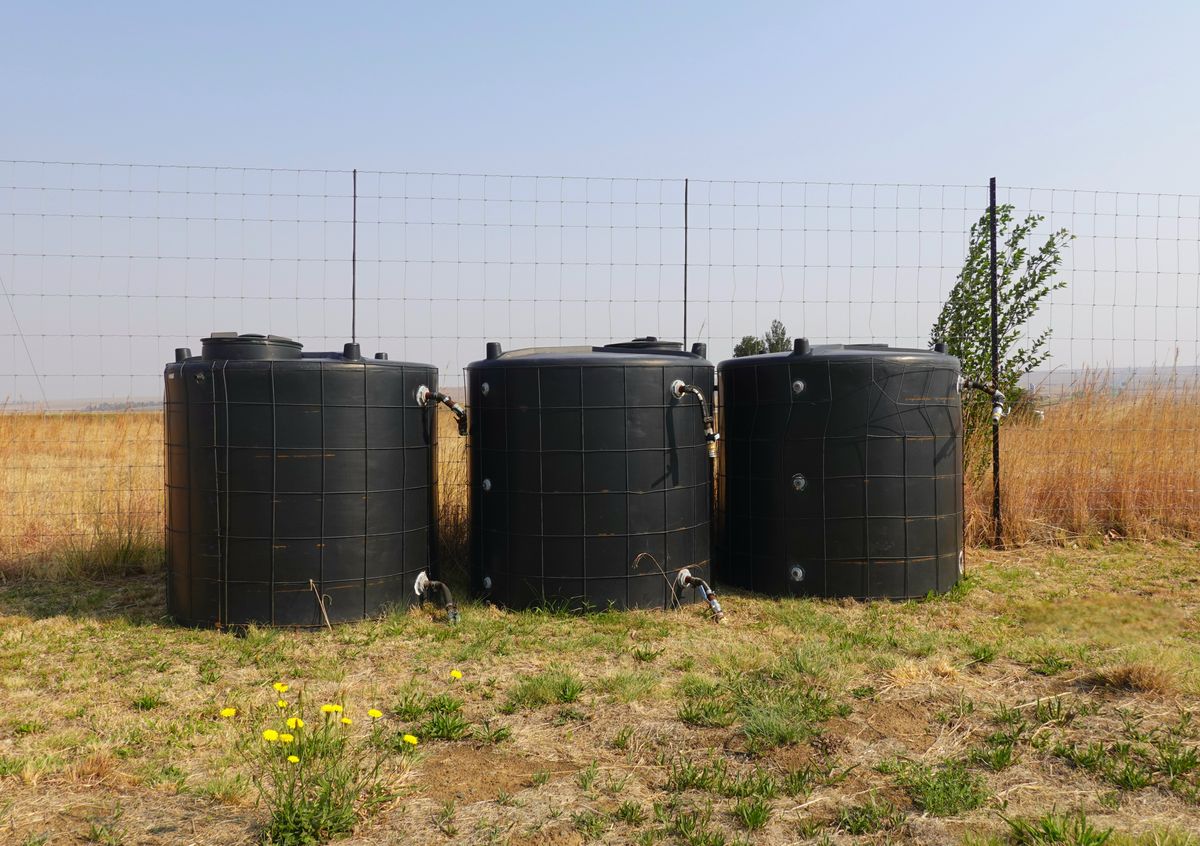
When a borehole is drilled and a pump installed, the work is only partially done. The water needs somewhere to go — and the decision about how and where to store it has a significant bearing on how reliably your borehole system performs day-to-day. Two principal options exist: an overhead (elevated) tank that uses gravity to distribute water through the property, and an underground tank that holds water below ground and requires a pressure pump to deliver it. Both are widely used in South Africa, both have real advantages, and both have trade-offs that matter in practice.
This article walks through how each option works, where each excels, how sizing decisions are made, what materials are available, and why a hybrid system combining both approaches often delivers the best of both worlds — particularly for solar-powered borehole installations.
Why Storage Tanks Matter for Borehole Water Systems
A borehole submersible pump draws water from depth and pushes it to the surface. Without a storage buffer, the pump would need to run every time a tap is opened — cycling on and off throughout the day. This start-stop cycling is hard on pump motors, reduces service life, and creates pressure fluctuations at the outlet that are noticeable in daily use.
Storage tanks decouple the pump's operating schedule from the property's demand pattern. The pump runs for a defined period — filling the tank — and then stops. The household draws from the tank continuously, at whatever rate it needs, without affecting pump operation. This is far more efficient and extends pump life considerably.
Beyond the operational logic, storage tanks also provide a critical buffer during periods when the pump cannot run: power outages, pump servicing, or temporary borehole yield drops. How much buffer you have — and how it's delivered — depends directly on the tank type you choose.
In South Africa's context of frequent load shedding and unreliable grid power, storage capacity becomes even more important. A property with sufficient storage and a well-designed distribution arrangement can go through a full 12-hour load-shedding block without experiencing any interruption to water supply. The design of that arrangement starts with the choice between overhead and underground.
Overhead (Elevated) Tanks: Gravity Does the Work
An overhead tank is mounted on a raised structure — a steel stand, a purpose-built tower, or an elevated platform on an existing building — at a height above the highest point of water use on the property. Gravity drives the water downward through the distribution pipework, creating pressure at every outlet below the tank level.
How gravity pressure works: The pressure generated is purely a function of vertical height. Every 10 metres of vertical difference between the tank outlet and the point of use produces approximately 1 bar (100 kPa) of pressure. For a standard single-storey South African home, a tank mounted at 4 to 6 metres above ground level typically delivers between 0.4 and 0.6 bar — sufficient for taps, toilets, and most shower fixtures. For properties with a second storey, or for fixtures requiring higher pressure such as instant gas water heaters, the tank needs to be mounted higher or a booster pump added downstream.
Common capacities: Overhead tanks in residential borehole installations typically range from 2 500 litres to 10 000 litres. A 2 500 litre tank is a common entry point for a small to medium household and provides meaningful autonomy without requiring an excessively tall or heavy structure. A 5 000 litre tank is the most common choice for a four-to-six-person household with garden irrigation. Large properties with higher demand frequently install 10 000 litre tanks — sometimes in paired configuration on a single large stand.
Advantages of overhead tanks:
- No distribution pump required. Once the borehole pump has filled the tank, gravity distributes the water throughout the property without any additional electrical equipment. No pump means no pump to fail.
- Water supply during power outages. This is the single most significant advantage in the South African context. A full overhead tank delivers water to every outlet in the house during a load-shedding event, grid failure, or pump maintenance period — for as long as the stored volume lasts.
- Simple and passive distribution. Gravity-fed systems are inherently simple. There are no pressure tanks, no pressure switches, no booster pump controllers to maintain or programme.
- Works perfectly with solar borehole pumps. A solar pump fills the overhead tank during daylight hours. The household draws from the tank around the clock — through the night, during cloudy periods, and during any power interruption. This pairing is the most resilient borehole configuration available.
- Lower long-term operating cost. No booster or distribution pump means no associated electricity consumption for distribution — only the borehole pump's energy to fill the tank.
Disadvantages of overhead tanks:
- Visual impact. A large tank on a raised structure is visible from the property and neighbouring properties. In residential estates and aesthetically-sensitive developments, this can be a significant drawback. Some local by-laws impose restrictions on structures above a certain height.
- Structural support requirements. A 5 000 litre tank full of water weighs five tonnes. The support structure must be engineered to carry this load safely. Steel tank stands need periodic inspection and rust-proofing. Concrete bases must be adequate. The civil cost of the stand is often comparable to the tank itself.
- UV degradation of polyethylene tanks. Standard polyethylene storage tanks are not designed for long-term overhead installation — they are not rated for the structural loads or the UV exposure that elevated installation involves. Only tanks specifically rated by the manufacturer for overhead use (JoJo's overhead range, for example) should be installed at height. Off-specification installation can lead to catastrophic tank failure. Always verify the tank's overhead rating with the manufacturer before installation.
- Pressure limitations at height. For multi-storey properties, achieving adequate pressure at upper-floor outlets from a gravity-fed overhead tank requires either impractical tank heights or a downstream booster pump — partially undermining the gravity advantage.
Underground Tanks: Out of Sight, Naturally Cool
An underground tank is buried below ground level, typically in a purpose-excavated pit. The tank is filled by the borehole pump, stores the water below grade, and then supplies a pressure pump (also called a transfer pump or booster pump) that pressurises the property's distribution system on demand.
JoJo's dedicated underground range is the most widely used product in this category in South Africa. These tanks have thick, ribbed polyethylene walls specifically engineered to resist the compression loads of surrounding soil — they are not simply standard tanks buried in the ground. Concrete underground tanks, either pre-cast or site-built, are an older but still practical alternative, particularly for very large capacities. Fiberglass underground tanks are also available and are favoured in some commercial applications for their strength-to-weight ratio and chemical resistance.
Advantages of underground tanks:
- No visual impact. A buried tank is entirely out of sight. The only visible elements are the manhole cover, pump housing, and pipework connections — easily screened or incorporated into landscaping.
- Naturally cool storage temperature. Below-ground temperature is significantly lower and more stable than ambient surface temperature, particularly in summer. Cooler water storage inhibits algae growth and reduces the rate of any biological activity in the stored water. This is an inherent advantage over above-ground tanks that are exposed to direct sun and ambient heat fluctuations.
- No structural engineering requirement. The tank is supported by the surrounding soil — there is no steel stand or elevated platform to engineer, build, or maintain.
- Large capacities are practical. Underground tanks can be installed in very large capacities — multiple tanks linked together — without the height and structural constraints that limit overhead options.
Disadvantages of underground tanks:
- Requires a pressure pump for distribution. Water from an underground tank cannot flow to the house by gravity — it needs to be pressurised. This means an additional pump (typically a surface-mounted jet pump, pressure pump, or variable-speed pressure system) is required for distribution.
- Pump failure means no water. This is the most consequential disadvantage in load-shedding conditions. When the grid fails and there is no battery or solar backup for the distribution pump, an underground tank provides no water to the property — despite having a full tank below ground. The water is there; the pump to move it is not running.
- Additional equipment to maintain. A pressure pump, pressure switch or controller, pressure vessel, and associated pipework are all additional components with their own maintenance and replacement schedules.
- Excavation and installation cost. Burying a large tank requires excavation, correct bedding, proper backfilling, and a reinforced manhole access structure. This can add meaningfully to the total installation cost compared to a surface tank.
The load-shedding test: Ask yourself this question before deciding on tank type — if the power goes out for 12 hours tonight, do you want water from your storage? An overhead tank says yes, unconditionally. An underground tank says only if you have solar or battery backup for the distribution pump. In South Africa's current energy environment, this is not a hypothetical scenario.
Hybrid Systems: Underground Collection Plus Overhead Header
The most robust configuration for a South African borehole installation combines both tank types in a deliberate hybrid arrangement. This is increasingly the design of choice for property owners who want maximum resilience and are not willing to compromise on either storage capacity or load-shedding performance.
The hybrid layout works as follows:
- The borehole pump fills a large underground collection tank. This is the primary storage reservoir — typically 5 000 to 10 000 litres or more, depending on the property's demand. The underground tank provides the buffer for pump operation and acts as the main water reserve.
- A transfer pump (or a solar-powered surface pump) moves water from the underground tank to a smaller overhead header tank — typically 2 500 to 5 000 litres — mounted on a raised structure above the property.
- The overhead header tank distributes water to the property by gravity, without any further electrical input.
The result: you get the large, invisible storage capacity of an underground tank, combined with the gravity-fed, power-independent distribution of an overhead tank. During a load-shedding event, the overhead header tank continues to supply the property for as long as its volume lasts — typically 12 to 24 hours for a normal household, depending on consumption and tank size.
The transfer pump that moves water from underground to overhead can itself be solar-powered or battery-backed, further extending the load-shedding resilience of the system. In a fully solar-configured system, the borehole pump fills the underground tank, the solar transfer pump fills the overhead tank from the underground reserve, and the household draws from the overhead tank by gravity — all without grid dependency.
Sizing Your Storage: Calculating What You Need
Tank sizing is straightforward in principle: you need to store enough water to bridge the longest likely gap between pump operating periods, while meeting the property's consumption during that period.
The calculation has two inputs:
- Daily household consumption: A practical average for a South African household is 150 to 250 litres per person per day for indoor use, plus additional allowance for garden irrigation. A four-person household with moderate garden watering might use 800 to 1 200 litres per day.
- Days of autonomy: How many days of pump-off operation do you want to be able to sustain? One day is a minimum — covering most power outages. Two days provides a comfortable buffer. Three or more days is appropriate where load shedding is extended or pump servicing requires multi-day downtime.
Multiply daily consumption by desired autonomy days, then add a safety margin of 20 to 25%. For a four-person household using 1 000 litres per day and wanting two days of autonomy: 1 000 × 2 × 1.25 = 2 500 litres minimum. A 5 000 litre tank would give four days of comfortable autonomy — a common practical choice.
For properties with significant irrigation requirements, garden water use in summer can exceed indoor consumption. A separate irrigation meter on the borehole system, pulling from the underground storage directly via the submersible pump's primary circuit, is often more efficient than sizing the household header tank to accommodate irrigation volumes.
Materials: Polyethylene, Fiberglass, Steel, and Concrete
The material choice for your storage tank depends on the installation type, the volume required, and the physical environment of the site.
Polyethylene (PE) — JoJo and equivalent brands: The dominant material choice for residential and light commercial borehole storage in South Africa. Lightweight, food-grade, UV-stabilised for above-ground use, corrosion-proof, and available in a wide range of capacities. JoJo's above-ground tanks come in vertical and horizontal formats; their overhead range carries the manufacturer's overhead rating. Underground PE tanks have ribbed walls for soil load resistance. Typical lifespan with correct installation exceeds 20 years. This is the default recommendation for most residential applications.
Fiberglass (GRP — Glass Reinforced Plastic): Higher strength-to-weight ratio than PE, good chemical resistance, and available in larger single-unit capacities than PE. Used frequently in commercial and agricultural applications where large volumes are needed in above-ground or underground configurations. Higher cost than PE but appropriate where volume or chemical environment warrants it.
Steel (galvanised or coated): Corrugated steel tanks in large capacities are used on farms and commercial properties. Durable, repairable, and available in very large capacities. Requires a liner for potable water storage to prevent corrosion contamination. Internal liners need periodic inspection and replacement.
Concrete: Site-built or pre-cast concrete underground tanks are a traditional and durable option. Very large capacities are achievable. Concrete underground tanks require waterproofing treatment internally to prevent ingress and leaching. Over time, cracks can develop and require repair. Pre-cast concrete tanks with factory-applied coatings offer good longevity. Generally not the first choice for new residential installations where PE underground tanks are available, but still widely used in commercial and agricultural contexts.
Solar-Powered Systems: Why Overhead Is the Natural Partner
A solar borehole pump operates during daylight hours, producing water when the sun is shining. At night, during cloud cover, and during grid-power-out periods, the pump does not run. This intermittent operating profile makes overhead tank storage the natural and preferred configuration for solar systems.
The solar pump fills the overhead tank during peak generation hours. The household draws from the overhead tank around the clock by gravity — through the night, through cloudy days, and through any duration of load shedding — without any further electrical input for water distribution. The match between the solar pump's filling profile and the gravity distribution arrangement is close to ideal.
An underground tank with a mains-powered distribution pump is a poor match for a solar borehole system unless the distribution pump is also on a solar or battery circuit. Without power, the distribution pump cannot run and the underground storage is inaccessible — which defeats the purpose of having water stored at all during a load-shedding event.
For solar-powered borehole installations, Everest Drilling's standard recommendation is an overhead tank sized for at least 48 hours of household consumption. This provides a comfortable buffer for nights, overcast periods, and pump servicing intervals, without requiring any grid or backup power for water delivery.
Related Articles
Common Questions
Design the Right Storage System for Your Borehole
Everest Drilling designs complete borehole systems including pump selection, tank sizing, and distribution layout. Contact us for a project-specific consultation.