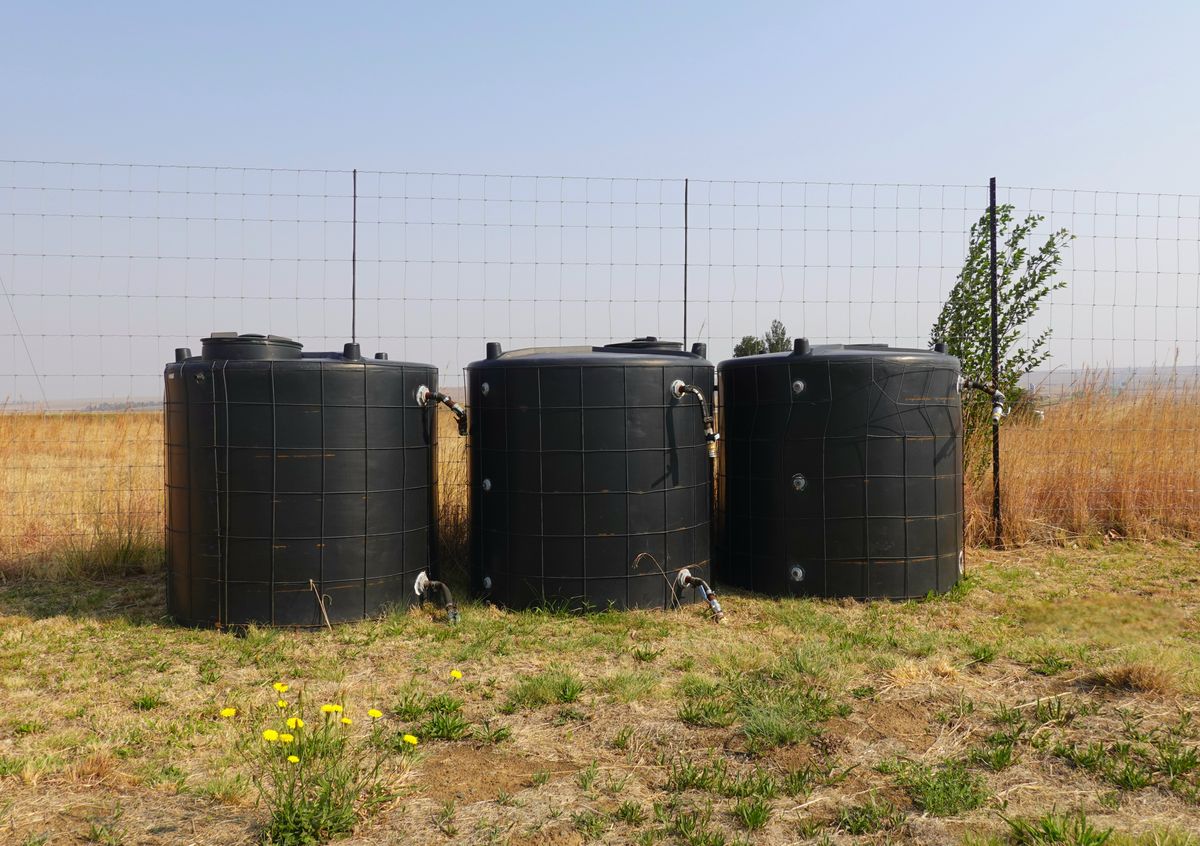
An overhead water tank is one of the most practical water supply components a South African property can have — yet it is also one of the least understood. The principle is simple: store water at elevation so gravity delivers it continuously without a pump running at the same time. In practice, a correctly designed overhead tank system transforms a borehole pump into a far more efficient and resilient water supply solution.
This guide explains how overhead tanks work, why tank height matters, how they integrate with borehole pump systems, and how to approach sizing one for your property.
What Is an Overhead Water Tank?
An overhead water tank is a storage vessel — usually polyethylene or steel — elevated above the property on a structural stand. The stand height places the tank's base above the highest outlet on the property (typically a first-floor tap, shower, or toilet cistern) to ensure gravity pressure at all points.
Water is pumped into the tank from below — either from the municipal supply or, in a borehole system, from a submersible pump at the bottom of the borehole. Once full, the tank acts as a pressurised gravity reservoir: water flows out of the tank base, down through distribution pipework, and to every outlet on the property without any pump assistance.
The pump only runs to fill the tank, not to supply each tap-on demand. This means the pump cycles less frequently, the property has water available during pump-off periods (including load shedding), and pressure to all outlets is consistent regardless of how many points are open simultaneously.
How Gravity Creates Water Pressure
Pressure in a water system is created by the height of water above the outlet — called the hydraulic head. The greater the vertical distance between the bottom of the tank and the outlet in question, the higher the pressure at that outlet.
As a general rule, every 10 metres of vertical height produces approximately 1 bar (100 kPa) of water pressure. Standard household fixtures — taps, toilets, showers — typically require between 0.5 and 2 bar to operate effectively. A tank elevated 5 metres above the highest outlet therefore delivers approximately 0.5 bar at that outlet, increasing at lower outlets in the property.
For properties on a single level, a tank stand of 4–6 metres typically delivers adequate gravity pressure. Properties with two or more storeys need careful calculation to ensure the tank is elevated high enough to maintain pressure at the highest outlet.
The Relationship Between Tank Height and Pressure
Tank height is determined by the layout of the property, the elevation of the highest outlet, and the minimum acceptable pressure at that outlet. Getting this calculation wrong results in either inadequate pressure at upper-floor outlets or a tank stand that is unnecessarily expensive to build.
- Height of highest outlet — the reference point for minimum head calculation
- Minimum acceptable pressure at highest outlet — typically 0.3–0.5 bar for basic function
- Pipe friction losses — longer distribution runs lose some pressure through friction; larger pipe diameter reduces this
- Number of outlets operating simultaneously — higher simultaneous demand reduces dynamic pressure; tank head compensates
- Tank stand structural capacity — a full 5,000-litre tank weighs approximately 5 tonnes; the stand must be engineered accordingly
How a Borehole and Overhead Tank Work Together
When paired with a borehole system, an overhead tank creates a complete, self-sustaining water supply cycle:
- The submersible pump runs — triggered automatically when the tank level drops below a set point (controlled by a float switch or level sensor at the tank)
- Water is pumped from the borehole — up the rising main, through the surface pipework, and into the overhead tank
- The pump switches off — when the tank is full, the float switch cuts power to the pump
- Gravity supplies the property — water flows from the tank base through distribution pipework to all outlets on the property, with no pump running
- The cycle repeats — as the property draws water from the tank, the level drops until the float switch triggers the pump again
This cycling behaviour is far gentler on the pump than running it continuously on-demand. It also means the property has stored water in the tank during any period when the pump cannot run — including load shedding — for as long as that stored volume lasts.
Load shedding resilience: A well-sized overhead tank buys significant supply buffer during load shedding. A 5,000-litre tank serving a 4-person household supplies approximately one to two days of water without the pump running at all — provided the tank is full when the outage begins. Combined with a solar-backed pump that refills the tank during daylight hours, the system operates fully independently of both Eskom and the municipal supply.
Tank Construction and Materials
Everest Drilling constructs overhead tank stands from structural steel, hot-dip galvanised after fabrication for corrosion resistance. Stand design is site-specific — the footprint, height, and bracing configuration are determined by the required tank height, the tank capacity, and the ground conditions at the installation point.
Tanks themselves are typically rotationally moulded polyethylene — UV-stabilised for outdoor installation and food-safe for potable water storage. Standard capacities range from 2,500 to 10,000 litres, with larger custom installations available for agricultural and commercial applications. Steel tanks are used for high-volume or industrial-duty installations where polyethylene tank capacity is insufficient.
The tank is fitted with an inlet (from the pump rising main), an outlet (to the distribution system), an overflow pipe (discharging safely away from the stand base), a float valve (preventing overfilling if the level control system fails), and a vent. All fittings are specified to the tank and stand in a complete engineered assembly.
What Size Tank Do You Need?
Tank capacity is determined by two variables: daily water consumption and the desired buffer period — how many hours or days of supply the tank should provide without the pump running.
Residential daily water use varies significantly by household size, garden irrigation, and lifestyle. As a general planning figure for sizing purposes, consider the property's likely peak daily demand and the pump's flow rate. A pump that fills the tank in a reasonable run-cycle time, combined with a tank capacity matching one to two days of demand, is a typical starting point for a residential installation.
Agricultural and commercial tanks must account for crop irrigation cycles, livestock requirements, or process water demand — which can vary widely by operation type. Everest Drilling approaches tank sizing as part of the overall project design, not as a standalone calculation.
Overhead Tank vs Underground Tank
Underground tanks store water below ground and require a pressure pump to deliver water from the tank to the property. They suit sites where overhead structures are not practical — constrained space, aesthetic requirements, or high wind zones.
Overhead tanks deliver water by gravity — no additional pump is required once the tank is full. This simplicity is their primary advantage: fewer electrical components, lower running costs, and continued supply during pump-off periods. The trade-off is the visual footprint of the elevated stand structure and the civil engineering required for the stand foundation.
For most borehole-fed water supply installations, an overhead tank is the more practical and cost-effective storage configuration. The full range of Everest water storage solutions — including both overhead and underground options — is available for discussion at quotation stage.
Related Articles
Common Questions
Include a Tank in Your Borehole Project
Everest Drilling designs and installs complete borehole systems — drilling, pump, stand, and tank — as a single turnkey project. Contact us to discuss what your property needs.