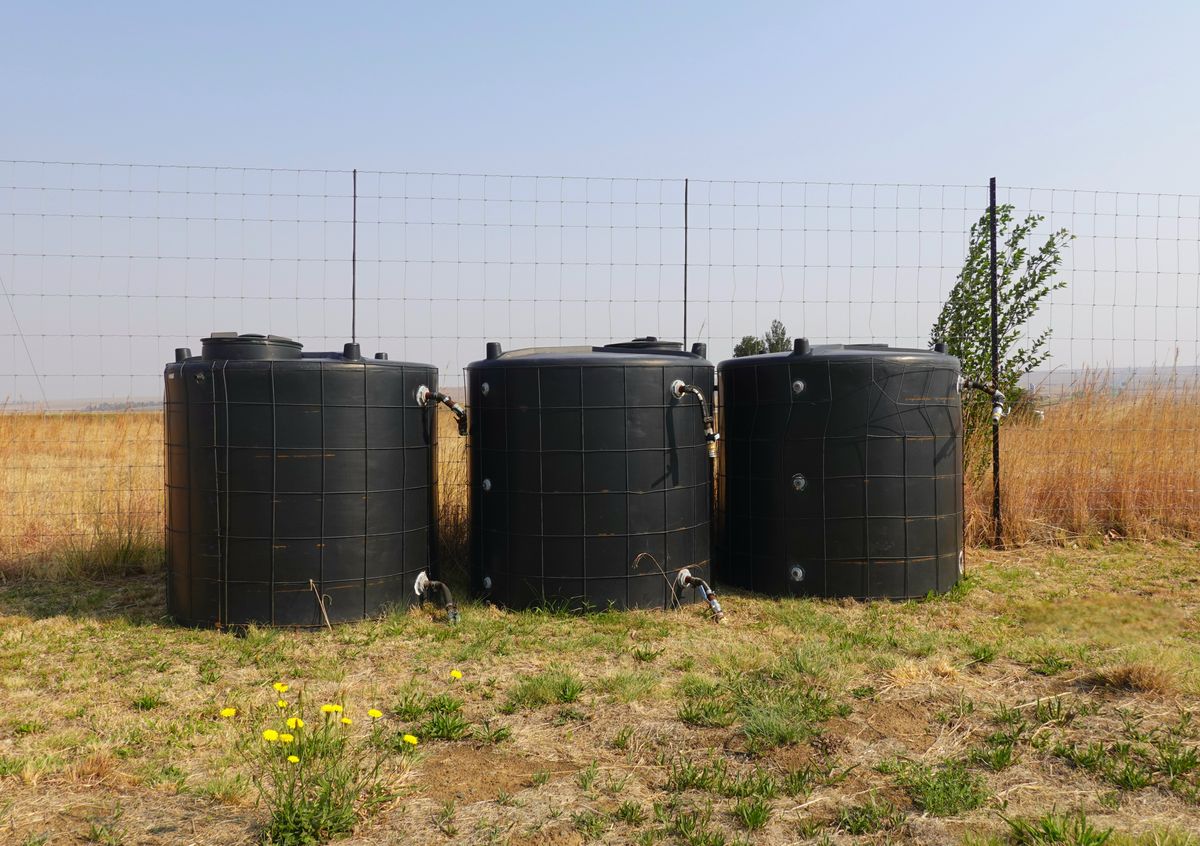
An overhead storage tank is the recommended completion for any borehole system. Rather than running the pump on demand every time a tap is opened, the pump fills the elevated tank at its own pace, and the tank supplies the property by gravity at any flow rate the distribution system allows. The result is consistent pressure, reduced pump wear, and water supply continuity even if the pump is temporarily offline.
Why Elevated Storage Matters
Gravity-fed water pressure is simple, reliable, and requires no pressure pump to maintain. As long as the tank contains water and is elevated sufficiently above the distribution system, water flows to every outlet without any electrical input. This makes the overhead tank essential for:
- Solar pump systems — the tank stores water pumped during the day for nighttime supply
- Low-yield boreholes — the tank accumulates water slowly and delivers it on demand at a higher flow rate than the borehole alone could sustain
- Backup supply — if the pump requires maintenance or the borehole is temporarily resting, the tank provides a supply buffer
- Pressure independence — no pressure pump, pressure vessel, or electricity required to maintain supply pressure
How Gravity-Fed Supply Works
Every metre of elevation between the base of the tank and the water outlet provides approximately 0.1 bar of water pressure. A tank elevated 10 metres above the highest outlet on the property provides approximately 1 bar at that outlet — sufficient for most domestic fixtures. Higher tanks produce higher pressure; the exact height required depends on your property layout and distribution system.
Tank height and pressure: For a single-storey property with roof outlets at approximately 4 metres above ground, a tank platform at 8–10 metres above ground level typically provides comfortable working pressure. Multi-storey buildings require greater elevation. Everest Drilling sizes the structure height for your specific property during the quotation process.
Sizing Considerations
Tank capacity is sized to match your property's daily consumption, with a buffer that accounts for your borehole's yield and, where applicable, the solar pump's daily output. Key factors:
| Factor | Why It Matters |
|---|---|
| Daily consumption | The tank must hold at least one full day's supply to ensure uninterrupted delivery |
| Borehole yield | A low-yield borehole needs a larger tank to accumulate adequate volume before demand peaks |
| Solar pump hours | Shorter daylight pump hours mean less fill time — a larger tank compensates for cloudy days |
| Number of outlets | Higher simultaneous demand requires greater tank capacity and potentially a larger diameter supply line |
| Property size | Farms with livestock and irrigation require substantially larger volumes than domestic residential properties |
Construction Materials
Overhead tank structures are constructed to suit the site conditions, tank size, and required elevation. Typical construction uses:
- Steel structure — for most residential and light commercial installations; hot-dip galvanised or painted for corrosion resistance
- Reinforced concrete — for large commercial installations or where permanent structures are preferred
- Polyethylene (poly) tanks — the most common tank material for domestic and farm installations; UV-stabilised, food-grade, low maintenance
- Steel or fibreglass tanks — for larger-volume commercial and agricultural applications
Pairing with Solar Pump Systems
An overhead tank and a solar pump are the natural pairing for any off-grid or load-shedding-resilient water supply. The solar pump runs during daylight, filling the tank. The tank supplies the property around the clock. A float valve in the tank automatically shuts off the pump when the tank is full, preventing overflow and protecting the pump from running against a closed system.
See: Solar Borehole Pump Systems
Frequently Asked Questions
How big a tank do I need for my borehole system?
Tank sizing depends on your property's daily water consumption and the borehole's sustainable yield. As a general principle, the tank should hold at least one full day's consumption — and ideally more if the borehole yield is low or solar pump output varies with weather. Everest Drilling sizes tanks based on your specific consumption estimate and borehole yield data.
What height should an overhead tank be?
The height of the tank above the highest water outlet on the property determines the water pressure at that point. Every metre of height above the outlet provides approximately 0.1 bar of pressure. Most domestic distribution systems require a minimum of around 1 bar at the tap — meaning the tank base needs to be at least 10 metres above the highest outlet for comfortable pressure. Actual height requirements depend on your property layout and distribution system.
Can an overhead tank work with a solar pump?
Yes — an overhead tank is the recommended completion for any solar pump system. The solar pump fills the tank during daylight hours; the tank provides gravity-fed supply to the property at all times, including at night and during periods of cloud cover. The tank is the storage buffer that makes a daytime-only solar pump into a 24-hour water supply.