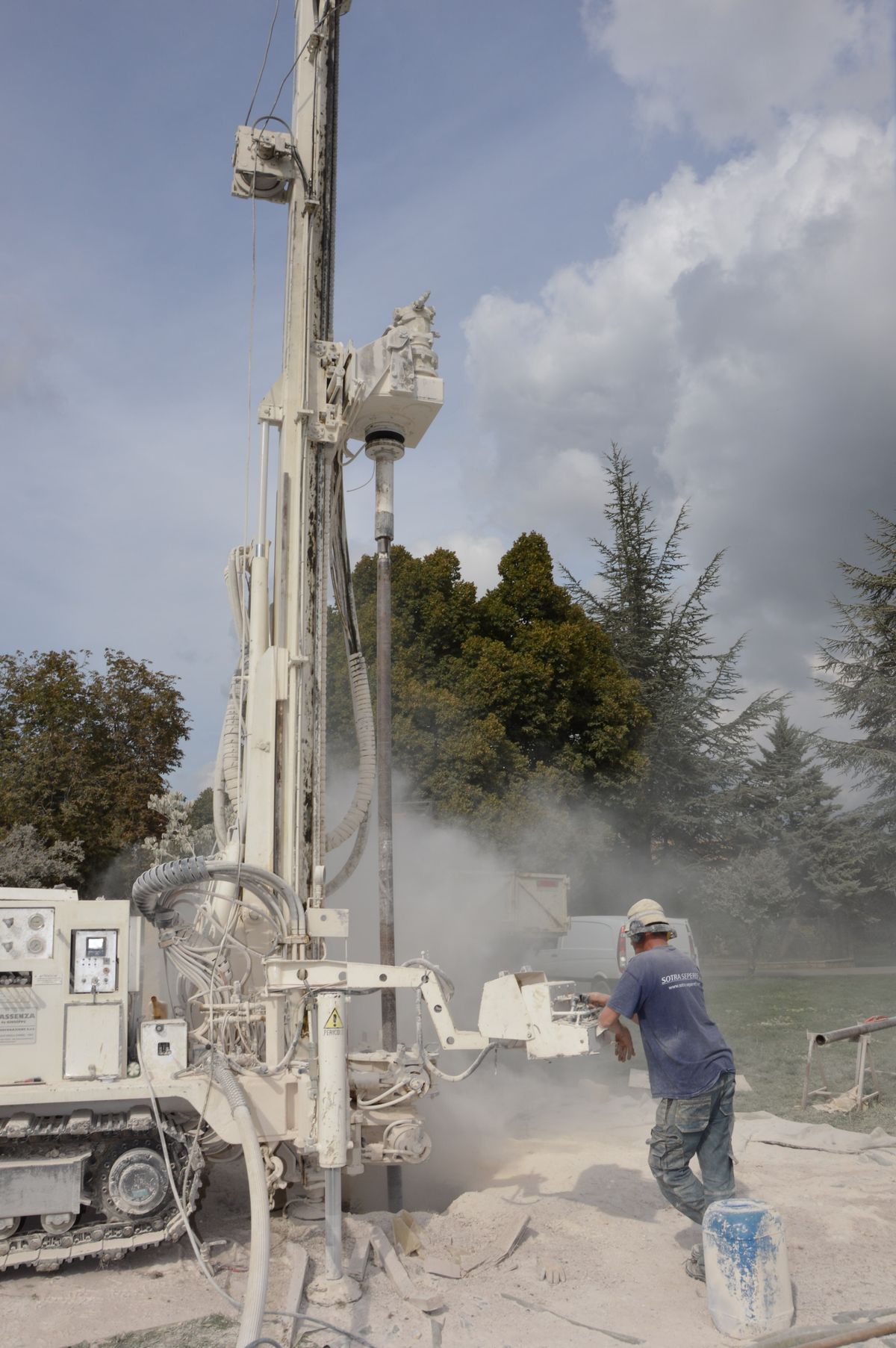
When people ask about borehole drilling, they tend to focus on depth and yield — how deep, and how much water. What often goes unasked is the question of what the drill actually cuts through on the way down. The answer matters enormously: the type of rock beneath your property determines the drilling method, the rig required, the penetration rate, the depth targets, the casing strategy, and ultimately the cost of the borehole.
South Africa's extraordinary geological variety means that two boreholes drilled 50 kilometres apart can encounter completely different rock environments — and require very different approaches to drill successfully. This article explains the two principal geological environments — hard rock and sedimentary — what they mean for the drilling process, and how Everest Drilling's equipment is suited to both.
Two Main Geological Environments in South Africa
South African geology can be broadly divided into two categories for the purposes of borehole drilling, though the reality is that many sites contain elements of both:
Hard rock environments are characterised by dense, strong, crystalline or well-cemented rocks that resist drilling and require significant force to penetrate. Examples include igneous rocks (granite, dolerite, gabbro), metamorphic rocks (quartzite, schist, gneiss), and well-cemented ancient sedimentary rocks that have been hardened through burial and geological pressure over hundreds of millions of years. Hard rock is found across large portions of South Africa — the Witwatersrand quartzites of Gauteng, the dolerite intrusions of the Karoo, the Cape Supergroup sandstone and quartzite of the Western and Eastern Cape mountains, and the ancient basement rocks of Limpopo and the Northern Cape.
Sedimentary environments encompass softer, less-cemented rock and unconsolidated material — alluvial sand and gravel in river valleys, coastal dune sands, relatively soft mudstone and siltstone, and recent to sub-recent sedimentary sequences deposited in coastal and lowland settings. These materials are far easier to drill through than hard crystalline rock and generally allow faster progress. KwaZulu-Natal's coastal plain, the alluvial valleys of the Eastern Cape, and many lowland agricultural areas fall into this category.
In practice, many South African drilling sites are mixed — a layer of soft sediment over hard basement rock, or alternating hard dolerite sills within softer Karoo mudstones. Understanding this mixed environment before drilling begins is a key function of the geophysical survey.
Hard Rock Drilling: What the Rig Encounters
Drilling through hard rock is the most technically demanding environment in borehole construction. The rocks involved — Karoo dolerite, Witwatersrand quartzite, Cape Supergroup sandstone and quartzite, and crystalline basement granite and gneiss — have compressive strengths that range from challenging to extreme. Dolerite, in particular, is one of the hardest rocks commonly encountered in South African drilling and is notoriously resistant to penetration.
The standard method for hard rock borehole drilling in South Africa is down-the-hole (DTH) hammer drilling. In this method, a pneumatically powered hammer is placed at the bottom of the drill string, directly above the drill bit. Compressed air drives the hammer at high frequency — typically 700 to 1 500 blows per minute — while the drill string rotates slowly above it. The combination of percussion impact and rotation fractures and grinds the rock at the bit face, advancing the borehole. Cuttings are lifted to the surface by the compressed air returning up the annulus between the drill string and the borehole wall.
DTH hammer drilling is highly effective in competent hard rock because the impact energy is applied directly at the bit face, with minimal energy lost in the drill string. Penetration rates in hard rock vary by rock hardness and rig capability, but a well-equipped DTH rig in dolerite might advance at 3 to 8 metres per hour under good conditions. This is significantly slower than soft-formation drilling, which is reflected in the per-metre cost.
Hard rock drilling also places high demands on the drill bit. Tri-cone roller bits and button-type DTH hammer bits are fitted with tungsten carbide inserts designed to fracture rock through impact. In extremely hard or abrasive rock like quartzite, bit wear is rapid and replacement is frequent — adding to the cost. For this reason, the use of a correctly specified rig with adequate air compressor capacity is critical: insufficient air pressure reduces hammer efficiency and slows penetration, increasing time on site and cost.
The borehole wall in hard, competent rock is generally stable. Collapse of the borehole wall during drilling is uncommon in solid granite or quartzite, though fractured and weathered zones can present instability. Steel casing is typically installed only in the uppermost weathered or unconsolidated section of a hard rock borehole, with the competent rock below providing natural borehole support.
Sedimentary Drilling: Softer Formations, Faster Progress
Drilling in sedimentary formations — alluvial deposits, coastal sands, relatively soft Karoo mudstones, or unconsolidated colluvium — is a fundamentally different proposition. The materials are easier to cut, progress rates are faster, and the per-metre cost is generally lower than in hard rock.
The predominant drilling method for soft and semi-consolidated sedimentary formations is rotary mud drilling (also known as direct circulation or reverse circulation drilling in some configurations). A rotating drill bit cuts through the formation, and a drilling fluid — typically a water-bentonite mixture, commonly called "mud" — is pumped down through the drill string and returns to the surface through the annulus, carrying the cuttings with it. The drilling fluid also serves a second critical function: it maintains the borehole wall stability by creating hydrostatic pressure against the formation and depositing a thin "mud cake" on the borehole wall that prevents collapse of unconsolidated material.
In purely unconsolidated material — river sands, coastal alluvium, and shallow weathered zones — a technique called cable tool drilling or percussion drilling with casing advance is sometimes used, particularly for shallow boreholes. Steel casing is driven into the ground ahead of or alongside the drilling, preventing the borehole walls from collapsing as drilling progresses. This is effective in very loose material but is slower and less common for the deeper boreholes typical in South Africa.
Sedimentary formations generally require more thorough casing installation than hard rock boreholes. Because the formation material — sand, silt, or soft rock — cannot support itself against the borehole wall, PVC or steel casing must be installed to full depth in most cases, fitted with a factory-slotted screen section opposite the productive aquifer zone to allow water to enter while excluding fine material.
How Geology Affects Cost and Time
The direct cost implications of hard rock vs sedimentary drilling are significant enough that any project budget should account for the likely geological environment rather than using a generic national average:
- Penetration rate. In soft sediment, a rig may advance 20 to 40 metres per hour. In hard dolerite or quartzite, 3 to 8 metres per hour is typical. The same borehole depth in hard rock takes 3 to 10 times longer to drill — and drilling time is the primary driver of cost.
- Bit and consumable wear. Hard rock wears drill bits, drill rods, and hammer components far faster than soft rock. Replacement costs are built into the per-metre rate for hard rock drilling but are a significant real cost difference.
- Compressor size. Effective DTH hammer operation requires a high-capacity compressor delivering sufficient air volume at adequate pressure. Larger compressors are more expensive to operate and transport, adding to hard rock project costs.
- Casing requirements. Sedimentary boreholes typically require more casing than hard rock boreholes, which are often self-supporting through the competent rock section. Full-depth casing in deep sedimentary boreholes adds material cost.
- Time on site. Mobilisation and demobilisation of a drilling rig is a fixed cost regardless of depth. A hard rock borehole taking three days to drill incurs the same mobilisation cost as one taking one day — and the additional two days of rig hire add substantially to the total.
None of these factors make hard rock drilling a poor investment — the yields from productive fractured rock aquifers often justify the additional cost. But a project-specific quotation based on the actual geological conditions at your site gives a far more accurate budget picture than a generic per-metre rate.
The Eastern Cape: A Mixed Geological Environment
The Eastern Cape deserves specific mention because it presents one of South Africa's most common and most instructive mixed geological environments — a combination of soft Karoo Supergroup sedimentary rocks and hard dolerite intrusions that requires both sedimentary and hard rock drilling capability in the same borehole.
A typical Eastern Cape borehole drilled away from river valleys begins by penetrating a thin layer of soil and weathered material — a few metres at most — before entering the Karoo sedimentary sequence. For the first 20 to 60 metres, the drill may be cutting through relatively soft mudstones and siltstones. Penetration is reasonably fast. Then the drill hits dolerite — sometimes a thin sill, sometimes a massive body tens of metres thick. The penetration rate drops dramatically. The rig hammers through the dolerite, which is often the key drilling target because the contact zone below the dolerite body, or the fractured halo around it, is where the highest-yield water is found.
This sequence — soft sediment, then hard dolerite, then potentially more sediment below — means the rig must be capable of handling both environments. A rig configured only for soft formation rotary drilling will struggle or fail when it hits a dolerite sill. A DTH hammer rig without adequate rotary capacity may have difficulty in the softer sedimentary sections. Everest Drilling's rigs are specified to handle the full range of geological conditions encountered across the Eastern Cape — from the alluvial flats of the Fish River valley to the dolerite-dominated Karoo interior.
Eastern Cape field note: Many Eastern Cape boreholes that initially appear to yield poorly in the soft Karoo sediments above a dolerite sill improve significantly once the drill penetrates the dolerite and reaches the fractured contact zone below. Stopping the borehole at the top of the dolerite rather than drilling through it is a common cause of avoidable drilling failure. This is why the geophysical survey interpretation — which identifies the full depth of the dolerite body — is critical to scoping the correct drill depth before mobilising the rig.
Rig Selection: Everest Drilling's Industrial Fleet
Everest Drilling's fleet comprises industrial-grade rotary percussion rigs capable of operating in both hard rock and sedimentary environments. The rigs are selected and configured for the full range of geological conditions encountered across South Africa — not single-application machines that can only handle one formation type.
For hard rock drilling — dolerite, quartzite, and crystalline basement granite — the rigs operate with high-capacity DTH hammer systems driven by large-volume air compressors. The hammer systems are sized to deliver adequate impact energy at the bit face even at depths beyond 100 metres, where compressed air must travel a significant distance down the drill string before reaching the hammer. Undersized compressors at depth are a common cause of slow penetration and borehole deviation in hard rock — a risk that Everest Drilling's equipment specification is designed to avoid.
For sedimentary environments and mixed geology, the rigs can switch between DTH and rotary drilling modes, and carry the drilling fluid handling equipment — mud pumps, settling tanks, and mixing equipment — required for rotary mud drilling in loose or unconsolidated formations.
Casing installation capability is standard across the fleet. Whether a borehole requires 152 mm (6-inch) steel casing for a hard rock borehole or full-depth PVC casing with slotted screen for a sedimentary installation, Everest Drilling's team handles the complete casing and grouting process as part of the turnkey drilling contract.
Rig selection for a specific project is based on the geophysical survey output and the hydrogeologist's interpretation of the likely geological sequence at the drilling site. Contact Everest Drilling for a project-specific quotation — the quotation will specify the rig, method, depth, and casing design appropriate to your site's geology.
Related Articles
Common Questions
Drilling in Hard Rock or Soft Ground — We Handle Both
Everest Drilling's industrial rigs are equipped for the full range of South African geology. Contact us for a project-specific quotation.