The Challenge
The Eastern Cape has one of South Africa's most unreliable municipal water supply networks outside the major urban centres. Many rural and peri-urban properties face a combination of ageing infrastructure, low pipe pressure, seasonal service interruptions, and — in some areas — multi-day outages that can leave households without running water entirely. For a household that depends solely on the municipal connection, there is no fallback when the supply fails.
The property in this case was a rural residential home set back from the nearest town, with a large garden and outbuildings that added to the household's daily water demand. The owners had experienced a pattern of increasingly frequent and prolonged outages over several years. Water storage in drums and tanks at ground level helped in the short term, but the household was still disrupted every time the supply dropped — and the cost and inconvenience of trucked water deliveries during extended outages had become unsustainable.
The owners' goal was straightforward: become entirely independent of the municipal supply for all day-to-day household water needs. They wanted a system that would work without grid electricity — an important constraint, as the property occasionally experienced power outages at the same time as water outages — and that would provide a consistent, gravity-fed pressure to the house without the need for a pressure pump or ongoing electricity cost for distribution.
A further consideration was the long-term nature of the investment. The owners were not looking for a temporary fix. They wanted a properly engineered solution — a drilled borehole with professional equipment, not a shallow hand-dug well — that would serve the property reliably for decades.
The Core Problem
An unpredictable municipal supply with no backup, in a location where trucked water is expensive and groundwater — if properly developed — is the most viable long-term solution. The challenge was not just to find water, but to find it in sufficient and reliable quantity, and to deliver it to the household in a way that removed all dependency on grid electricity and municipal infrastructure.
The Everest Drilling Approach
Everest Drilling's process for a project like this begins well before the drill rig arrives on site. The sequence follows a deliberate, survey-first approach that reduces risk, eliminates guesswork, and ensures the completed system is engineered for the property's specific geology and demand profile.
Site Assessment and Geophysical Survey
Before any drilling quotation is finalised, Everest conducts a geophysical survey of the property. On the Eastern Cape interior, groundwater is predominantly found in fracture zones within Karoo sedimentary rock and associated dolerite intrusions — features that are completely invisible from the surface. The survey uses electrical resistivity profiling and, where applicable, electromagnetic methods to map the subsurface and identify the fracture zone most likely to yield a productive borehole. The target position and recommended drilling depth are determined from this survey data, not from guesswork or historical averages. This is the foundation on which the drilling scope, quotation depth, and casing design are all built.
Borehole Drilling and Casing
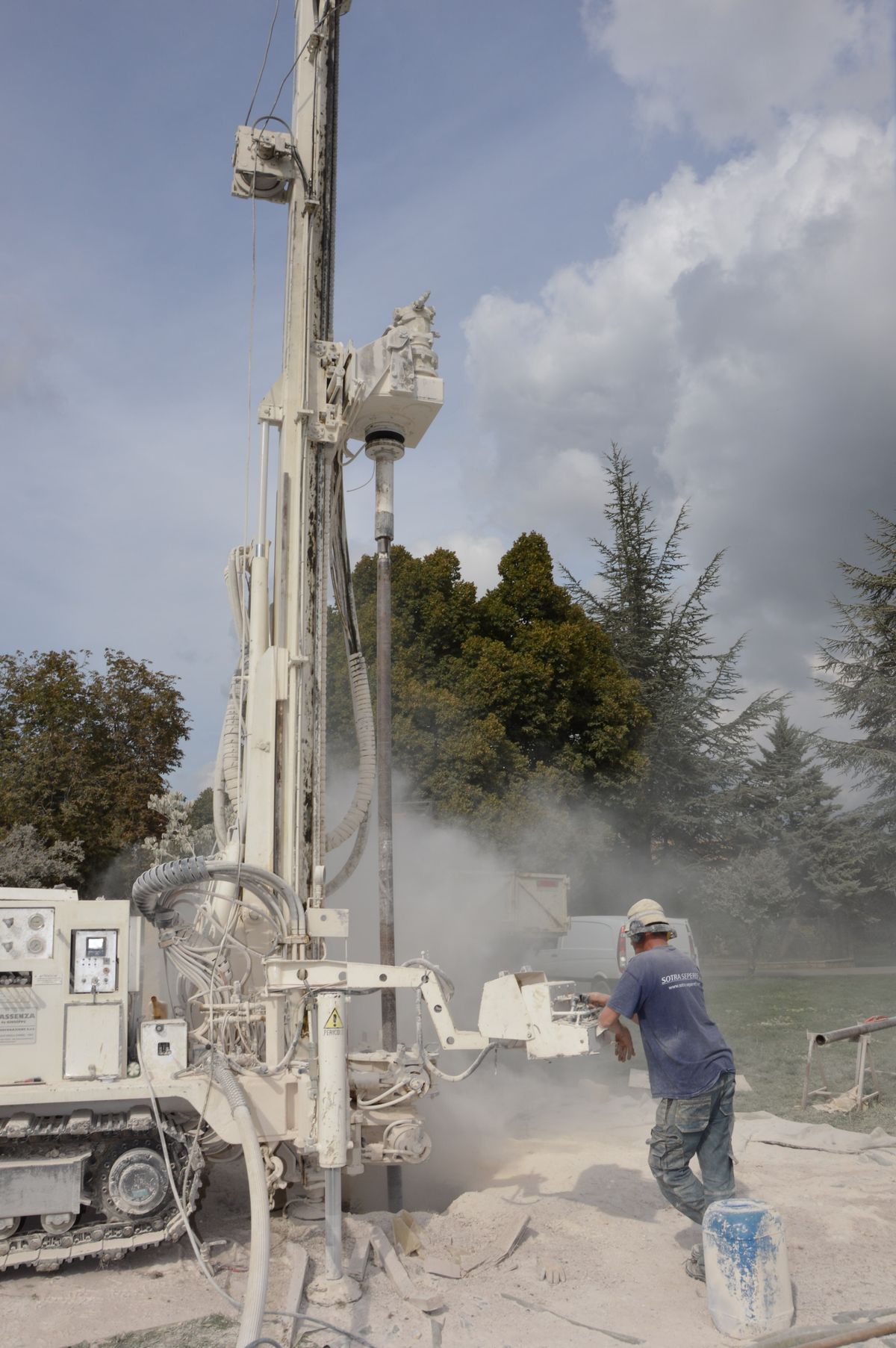
With the target zone identified, Everest mobilises the drill rig and drills to the depth determined by the geophysical survey. In the Eastern Cape's typical geological profile, this means drilling through a weathered overburden zone — which is cased immediately with solid uPVC casing to prevent wall collapse — before entering competent fractured rock. The solid casing is grouted at the annulus to prevent shallow groundwater from entering the borehole. The water-bearing fractures in the competent rock section are left as open hole, maximising the yield from the productive zone. On completion of drilling, a development pump is used to clear the borehole of drilling fines and to assess the yield before the permanent pump is selected. Everest Drilling guarantees the depth of the borehole as quoted and drilled.
Solar Borehole Pump Installation
A solar-powered submersible borehole pump was specified for this project — eliminating grid electricity as a dependency for water supply. The solar pump draws power from photovoltaic panels mounted on a suitable structure on the property. During daylight hours, the pump runs automatically, lifting water from the borehole to the overhead storage tank. The pump is sized to deliver sufficient yield for the household's daily demand within the available solar window, accounting for seasonal variation in panel output. The pump, rising main, and electrical cabling are installed inside the borehole casing, with the wellhead fitted and secured at surface.
5,000L Overhead Tank and Gravity Reticulation
The final component of the system is the 5,000-litre overhead storage tank, mounted at elevation on a purpose-built stand to provide gravity-fed pressure to the house. The elevated position of the tank means that water distribution to all taps, toilets, and appliances in the home is driven entirely by gravity — no additional pressure pump, pressure vessel, or electrical supply is required for distribution. The tank is connected to the borehole pump's rising main and fitted with a float valve that stops the pump automatically when the tank is full, preventing overflow. Reticulation pipework runs from the tank to the household supply points, effectively replicating and replacing the municipal connection with a private, independent water source.
The Outcome
The completed system delivers the water independence the owners set out to achieve. The household now draws its entire daily water supply from the borehole, with the solar pump operating during daylight hours to keep the overhead tank filled. When the sun rises, the pump starts. When the tank is full, the float valve stops it. When water is used in the house, the tank empties slightly and the pump runs again at the next solar window to refill it. The cycle is automatic, requires no manual intervention, and consumes no grid electricity at any stage.
The 5,000-litre storage capacity provides a meaningful buffer. Even on overcast days when solar panel output is reduced, the stored volume in the tank is sufficient to supply the household's daily demand without any shortfall. During extended periods of poor weather, the tank can be supplemented by running the pump during any available sunlight, or — in an extreme scenario — the system can be temporarily switched to grid power if needed, since the pump is compatible with both energy sources.
The gravity reticulation to the house delivers water at a consistent pressure to all points of use. Taps, showers, toilets, and washing appliances all function normally. The household's water supply is now entirely independent of the municipal network — outages in the municipal system no longer affect the property at all.
From a maintenance perspective, the system is straightforward. Solar panels require periodic cleaning to maintain output. The pump should be inspected and serviced on the schedule recommended by the pump manufacturer. The borehole itself — properly cased and developed — requires no routine intervention beyond what is needed for the pump. The overhead tank is inspected visually as part of normal household maintenance. No chemical dosing, pressure system servicing, or electrical running costs are required for day-to-day operation.
Key Takeaways
-
Start with a geophysical survey. Drilling without survey data is guesswork. The survey identifies the fracture zone, recommends the drill position, and informs the target depth — the foundation of everything that follows.
-
Solar pumping eliminates electricity dependency. A solar borehole pump runs entirely on daylight hours, removing the grid from the water supply equation entirely. This is particularly valuable in areas where power and water outages coincide.
-
An overhead tank with gravity reticulation removes the need for a pressure pump. Elevation provides pressure. A correctly sized and positioned overhead tank distributes water to the household without any additional pumping after the borehole pump has delivered it to storage.
-
Storage capacity matters. A 5,000-litre tank provides a realistic daily buffer that accommodates reduced solar output on overcast days without disrupting household supply. Undersizing the tank defeats the purpose of the system.
-
Proper casing protects the investment. A correctly cased and developed borehole — with solid casing through the weathered zone, annular sealing, and open-hole completion in competent rock — will perform reliably for decades with minimal maintenance.
-
Everest Drilling guarantees the depth of the borehole as quoted and drilled. The quotation depth is based on the geophysical survey. What is quoted is what is drilled — giving the property owner certainty over the scope and cost of the drilling phase.