The Challenge
For a manufacturing or light industrial business, water is not background infrastructure — it is an active input into daily operations. Process water, equipment cooling, parts cleaning, dust suppression, toilet and ablution facilities, and grounds maintenance all draw from the same supply. When that supply comes exclusively from the municipal network, the business carries two risks simultaneously: the cost risk of a high monthly municipal water bill, and the operational risk of production stoppages when supply is interrupted.
The Eastern Cape municipal water network, like networks across South Africa, is subject to planned and unplanned interruptions. Maintenance shutdowns, pressure fluctuations, burst mains, load-shedding effects on pump stations, and seasonal demand peaks all create periods where supply to commercial properties is reduced or cut entirely. For a household, an interruption of a few hours is an inconvenience. For a manufacturing facility mid-production, it can mean halted lines, cooled processes that need restarting from scratch, and production schedules that cannot be met.
The business owner in this case had been absorbing both pressures for some time. The monthly municipal water bill had grown to a point where it represented a meaningful operational cost — and had been escalating year on year ahead of broader cost increases. Simultaneously, the production team had been managing around supply interruptions with short-term workarounds: stored drums, reduced-pressure periods, and reactive adjustments to shift scheduling. These workarounds worked, but they absorbed management attention, introduced inefficiency, and could not scale if production volumes increased.
The question put to Everest Drilling was straightforward: could a borehole change the equation?
The Business's Water Risk — In Plain Terms
A manufacturing operation that sources 100% of its water from the municipality has no control over its input supply. Municipal tariff increases are passed directly to the business. Supply interruptions — regardless of their cause — translate immediately into production risk. The business has no buffer, no alternative, and no ability to manage that risk from within its own operations.
A borehole changes that. It introduces an alternative supply source that the business controls — one with stable ongoing costs, independent infrastructure, and no exposure to municipal network outages. The capital investment in a commercial borehole is typically recovered through reduced municipal expenditure over a period that varies by facility, and thereafter the operational cost profile improves materially.
The Everest Approach
Commercial borehole projects are not simply larger versions of residential installations. The scale of investment, the operational consequences of getting the design wrong, and the complexity of integrating borehole water into an existing industrial supply system all demand a more structured approach. Everest Drilling's process for this project followed a clear sequence from initial site assessment through to system commissioning.
Initial site assessment and feasibility. The engagement began with a site visit to understand the facility's water consumption profile — what processes used water, at what flow rates, at what times of day, and which of those uses were non-potable and therefore suitable for borehole supply. Not all facility water uses need to be potable. Process water, cooling circuits, cleaning-down operations, toilet flushing, and grounds irrigation can all draw from a borehole without the requirement for drinking-water treatment. Understanding which portion of the facility's total water demand fell into the non-potable category was the first step in determining what yield a borehole needed to produce to make a material difference to the business.
Geophysical survey. Before committing a drill rig to any location on the site, Everest Drilling commissioned a geophysical survey. This surface electromagnetic investigation scanned the subsurface geology beneath the property, mapping fracture zones, geological lineaments, and structural features in the underlying rock. In the Eastern Cape, groundwater in hard-rock geology is not stored in uniform saturated layers — it occupies fractures, fault contacts, and intrusive contacts at depth. The productivity of a borehole is almost entirely determined by how many of those fractures are intersected during drilling, and at what depth.
The geophysical survey identified a high-potential fracture zone beneath the site — a structural feature in the underlying geology where multiple fracture systems converge, creating conditions for a concentrated, productive aquifer target. This became the designated drill point. Selecting the drill point from survey data rather than visual inspection or guesswork is the single most important factor in maximising the probability of a productive commercial borehole.
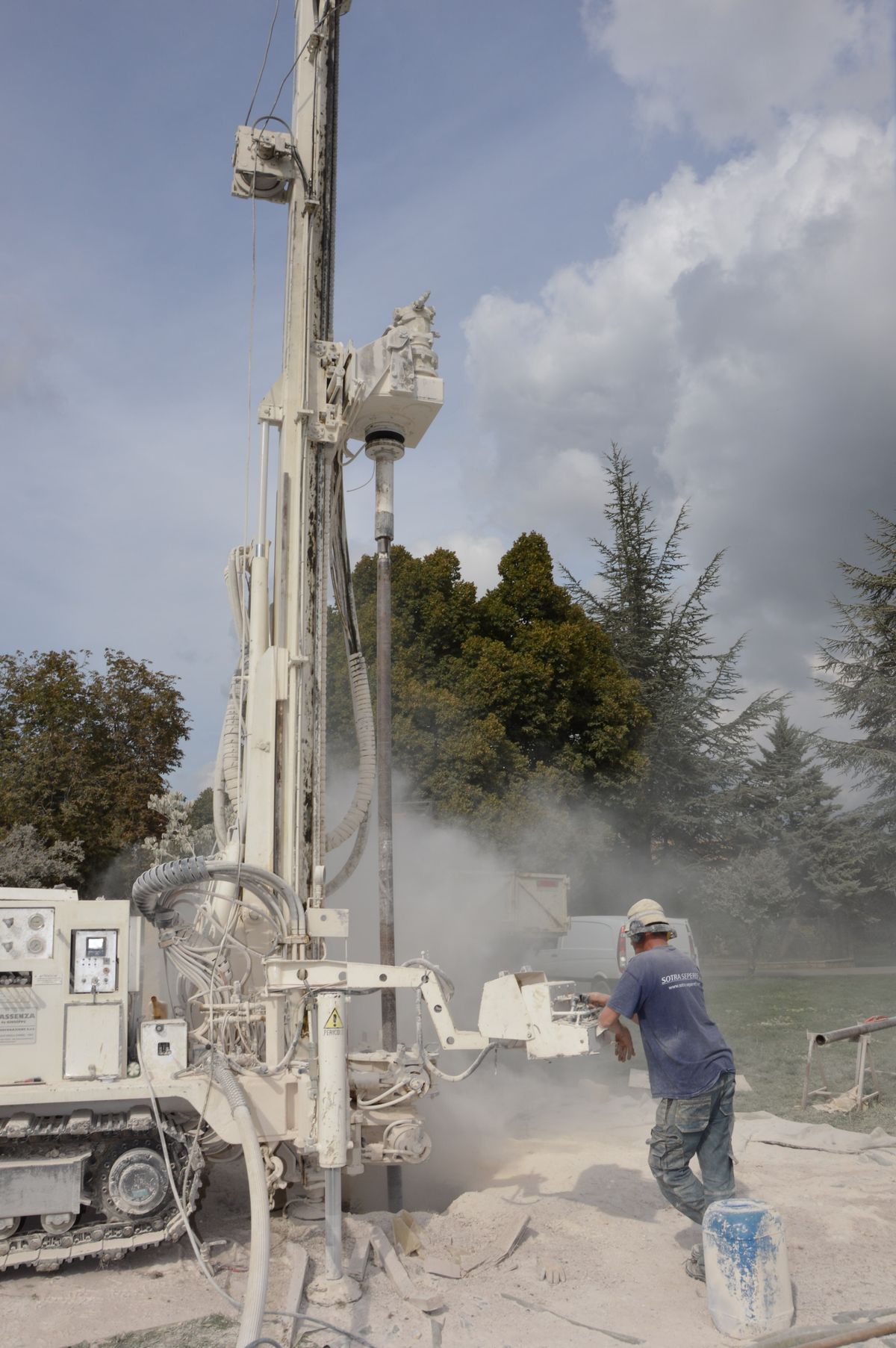
Commercial-grade drilling. With the survey data in hand, Everest Drilling mobilised an air-rotary percussion rig to the site and drilled to the depth determined by the geophysical survey, penetrating through the overburden and into the target fracture zone. The borehole was drilled to a larger diameter than a standard residential installation — sized to accommodate the high-capacity pump selected for this application and to allow the flow rates that commercial demand requires. During drilling, the formation was monitored continuously: the transition from weathered overburden to competent rock, the depth at which water was first encountered, and the behaviour of the water column as depth increased.
Casing was installed through the unstable upper section of the borehole and terminated at the point where competent rock was confirmed. Below the casing, the borehole was completed as open hole through the productive fracture zone, allowing direct inflow from the water-bearing fractures without restriction.
Yield development and testing. Before any pump was selected or installed, the borehole was developed — a process of high-pressure jetting and surging that clears drilling fines from the aquifer face adjacent to the open-hole section, opens fracture pathways that may have been partially blocked by drilling debris, and allows the borehole to demonstrate its full natural inflow capacity. Following development, a yield test was conducted: the borehole was pumped at a measured rate for a sustained period while the water level inside the casing was monitored. This established the sustainable yield — the rate at which the borehole can be pumped continuously without depleting the aquifer — and confirmed that the yield was sufficient for the facility's operational demand.
High-output submersible pump selection and installation. With yield data in hand, Everest Drilling specified a high-output multi-stage submersible pump matched to the borehole's confirmed sustainable yield. The pump was sized to deliver the flow rate required to fill the storage tank system within the facility's operating hours, without over-pumping the borehole. The pump was lowered on a rising main to the appropriate setting depth inside the casing, and a wellhead assembly was fitted at surface — a lockable cap over a concrete apron that seals the top of the borehole and provides the connection point for the rising main and power supply.
Large-capacity overhead tank system. A commercial borehole system does not supply water directly to point-of-use — it fills a storage reservoir that buffers between the borehole's sustained pumping rate and the facility's variable demand peaks. For this installation, Everest specified a large-capacity overhead tank system positioned to gravity-feed the facility's non-potable reticulation. The tank provides the reserve volume to handle peak-demand periods without the pump needing to run continuously, and acts as the buffer that keeps supply stable even if the pump is temporarily offline for servicing.
Reticulation to the facility. Pipework was designed and installed from the tank to the facility's existing non-potable water distribution points. The borehole system was kept deliberately separate from the potable municipal supply — clearly identified pipework, separate isolation valves, and labelled outlets to ensure there is no cross-connection between the borehole supply (non-potable process water) and the municipal drinking-water supply. A pump control panel with level-sensing float switches was installed: the pump activates automatically when the overhead tank drops below a set level and stops when the tank is full, requiring no manual intervention in day-to-day operation.
The Outcome
Following commissioning, the borehole system took over as the primary supply for the facility's non-potable water requirements. The overhead tank provides the capacity to absorb demand peaks and extended periods without the pump running, and the automated control system manages the fill cycle without operator attention.
The two risks that had driven the initial enquiry were addressed directly. Supply-interruption risk was effectively eliminated for the non-potable supply: the borehole and its storage tank operate independently of the municipal network, so outages on the municipal side have no impact on process water availability. The facility now has the buffer capacity to continue operations through interruptions that would previously have caused stoppages.
Municipal water expenditure was significantly reduced. The volume of municipal water now drawn by the facility is limited to its potable drinking-water requirements — a fraction of the previous total draw. The majority of the high-volume, non-potable uses that previously ran through the municipal meter are now supplied from the borehole at a materially lower ongoing cost. The capital investment in the borehole system is being recovered through this monthly saving.
Everest Drilling guarantees the depth of the borehole as quoted and drilled. The yield achieved, and the performance of the completed system, are the result of accurate geophysical survey interpretation, disciplined drilling practice, and correct pump and tank specification — all of which are within Everest's scope of work and professional accountability.
Key Takeaways
- A geophysical survey is non-negotiable for a commercial borehole — the investment in survey data before drilling protects a significantly larger investment in the borehole itself.
- Commercial borehole design starts with the facility's water demand profile, not with the borehole. Understanding what volumes are needed, at what flow rate, and for which uses determines every downstream specification.
- Yield testing before pump selection is mandatory. A pump matched to guesswork rather than measured yield either under-serves the facility or over-pumps the aquifer — both at a cost to the business.
- The overhead tank is as important as the pump. A storage buffer decouples the borehole's pumping rate from the facility's demand peaks and provides operational resilience if the pump requires servicing.
- Separating borehole supply (non-potable) from municipal supply (potable) with clearly identified pipework and isolation valves is a fundamental design requirement for any commercial installation.
- Automated pump control — level-sensing float switches that start and stop the pump based on tank level — removes the need for manual operation and protects the pump from running dry if the borehole rests during a high-demand period.
- The ongoing operational cost of a borehole system is principally electricity for pumping — substantially lower per kilolitre than municipal tariffs at commercial rates, particularly as tariffs escalate.
Common Questions
Ready to Assess Your Site?
Every commercial borehole project begins with a site assessment and geophysical survey. Contact Everest Drilling for a project-specific quotation — we do not offer standard pricing for commercial installations because no two sites are the same.