Irrigation is the single largest driver of agricultural borehole development in South Africa. The country's semi-arid climate, with its highly seasonal and unreliable rainfall, means that productive farming in most regions is dependent on supplementary water supply. Whether it is a smallholder growing vegetables for a local market, a commercial citrus or vegetable operation, a pasture farmer finishing cattle, or a emerging farmer establishing a first irrigated block, the borehole is often the foundation on which the enterprise is built.
But irrigation borehole supply is a different proposition from domestic or livestock supply. The volumes are larger, the run times are longer, the consequences of supply failure are more immediately visible in crop losses, and the planning that links borehole yield to irrigation system design must be done carefully to avoid costly mismatches. This article covers the fundamentals of irrigation water demand, how to match a borehole to that demand, and the pump and storage configurations that make borehole irrigation work reliably at scale.
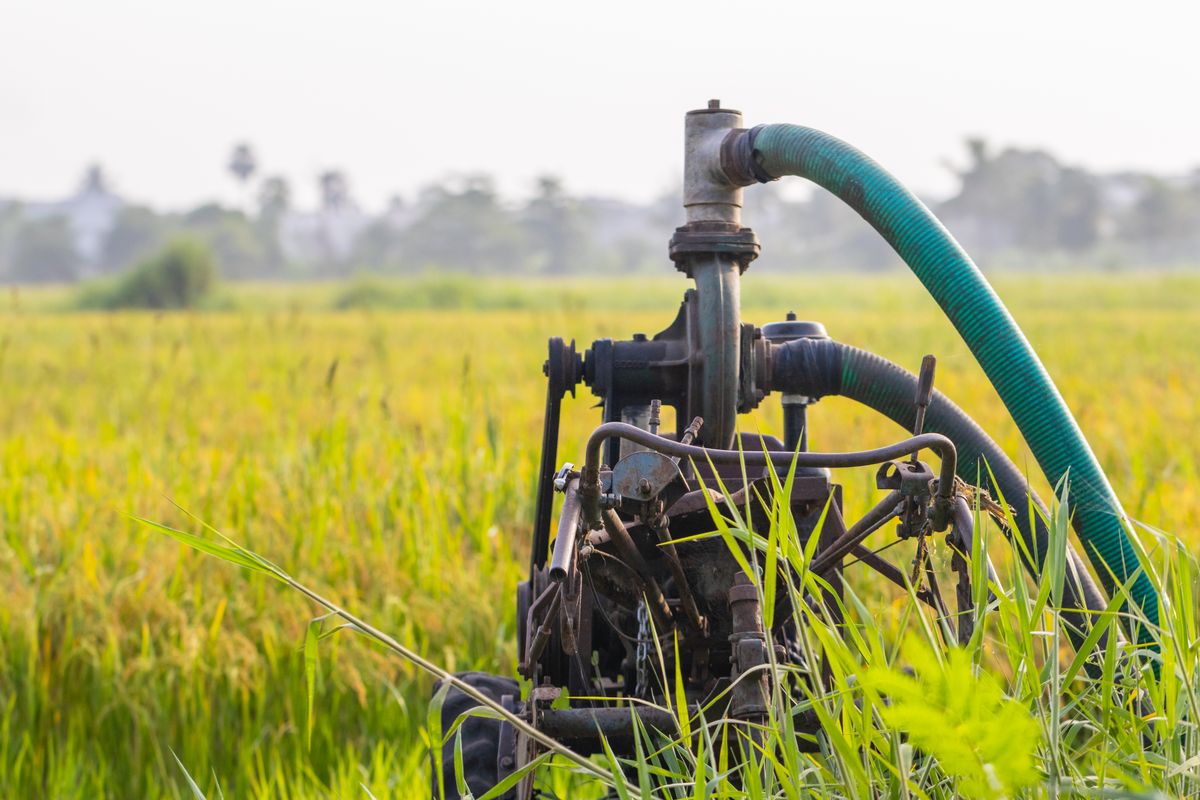
Why Irrigation Is the Biggest Driver of Farm Boreholes
Domestic and livestock water demand on most farms is relatively modest and predictable. A farmstead and staff quarters might use a few thousand litres per day. Livestock drinking demand scales with herd size but remains manageable even for large operations. Irrigation demand dwarfs both — and it is concentrated in the dry season, precisely when rainfall is least available and municipal supply (where it exists) is under maximum stress.
The economics of irrigation make self-reliant borehole supply compelling. A failed or restricted irrigation cycle during a critical growth stage — particularly for high-value horticultural crops — can damage a season's production far more than the capital cost of a borehole installation. An irrigation system that depends on municipal supply or a river allocation subject to drought restrictions is inherently fragile. A borehole drawing from a productive aquifer is the most reliable foundation for farm irrigation supply available to South African farmers.
Groundwater also has a practical advantage for irrigation scheduling: it is available on demand, 24 hours a day, independent of rainfall events or municipal operating hours. A well-designed borehole and pump system allows the farmer to irrigate when the crop needs water, not when supply is incidentally available.
Calculating Irrigation Water Demand
Accurate demand calculation is the starting point for any irrigation borehole project. Committing to drilling before this calculation is done risks either over-engineering the system (expensive) or finding the borehole inadequate for the intended area (more expensive). The key variables in irrigation demand are:
Irrigated area. The total area to be irrigated, expressed in hectares, is the primary scaling factor. All other demand figures multiply against this area.
Crop water requirement. Different crops have different evapotranspiration rates — the volume of water they use per day in the growing season. These rates also vary by season, growth stage, and local climate. Reference evapotranspiration (ETo) values for South African regions are well documented and provide the basis for crop-specific demand calculations. Broadly, summer vegetable crops in the Eastern Cape interior might use 5 to 8mm of water per day during peak summer, which translates to 50 000 to 80 000 litres per hectare per day at peak demand.
Irrigation method. The method of applying water to the field substantially affects both application efficiency and the flow rate required from the borehole system:
- Drip irrigation is the most water-efficient method — water is delivered directly to the root zone, minimising evaporation and runoff losses. Drip systems typically apply 2 to 4 litres per plant per hour, with application efficiencies of 90% or more. They run for longer periods at lower flow rates.
- Overhead (sprinkler) irrigation applies water more broadly and is suited to pasture, small grains, and crops where wetting the canopy is acceptable. Application efficiency is lower than drip — typically 70% to 80% — and evaporative losses are higher in hot, dry conditions. Higher instantaneous flow rates are required.
- Flood or furrow irrigation is the least water-efficient method, with application efficiency often below 60%. It requires the highest instantaneous flow rates and the largest storage volumes but remains common on established farms with flat land and appropriate soil types.
| Crop / Application | Typical Daily Demand | Method |
|---|---|---|
| Market garden vegetables (1 ha) | 30 000 – 60 000 L/day (peak season) | Drip or overhead |
| Pasture / kikuyu (1 ha) | 50 000 – 80 000 L/day (summer peak) | Overhead sprinkler |
| Citrus / orchard (1 ha) | 25 000 – 45 000 L/day | Drip or micro-sprinkler |
| Small grain crops (1 ha) | 40 000 – 70 000 L/day (critical stages) | Overhead sprinkler |
| Livestock drinking (100 cattle) | 3 000 – 5 000 L/day | Trough supply |
These figures are indicative. Actual demand must be calculated for the specific crop, locality, soil type, irrigation schedule, and system efficiency. An irrigation designer or agronomist should confirm the demand figure before borehole yield requirements are finalised.
Matching Borehole Yield to Irrigation Demand: The Yield Test
The most critical step in designing an irrigation water supply from a borehole is understanding what the borehole can actually, sustainably deliver — and matching that figure to the irrigation system's demand. This is done through a yield test conducted after drilling is complete.
A yield test (also called a pump test or step test) involves pumping the borehole at increasing rates and monitoring the water level inside the casing as pumping proceeds. The key outputs of a yield test are:
- Sustainable yield: The maximum rate at which the borehole can be pumped continuously without the water level falling below the pump intake depth. This is expressed in litres per hour or kilolitres per day.
- Specific capacity: The yield per unit of drawdown — how many litres per hour the borehole produces per metre of water level drop from rest. This characterises the aquifer's productivity at that point.
- Recovery rate: How quickly the water level returns toward the static water level after pumping stops. A fast recovery indicates a well-connected, productive aquifer; slow recovery suggests a less permeable system that must be pumped more conservatively.
The yield test result defines the borehole's sustainable abstraction rate — and this figure is the ceiling around which the irrigation system must be designed. There is no value in installing an irrigation system that demands 50 000 litres per hour from a borehole that can only sustainably deliver 20 000 litres per hour. The mismatch will result in the borehole being over-pumped, the water level dropping below the pump intake, and the pump running dry — causing pump damage and supply failure at the worst possible time.
Everest Drilling guarantees the depth of the borehole as quoted and drilled. Yield performance depends on the aquifer intersected — which is why geophysical surveying before drilling gives the best indication of likely productivity. A yield test after drilling gives the definitive sustainable rate on which irrigation design can be based.
Pump Sizing for Irrigation: Higher Volumes, Longer Run Times
Irrigation pump requirements differ fundamentally from domestic supply pump requirements. A household borehole pump may run for two to four hours per day, delivering water to an overhead tank at modest flow rates. An irrigation pump may need to run for eight, ten, or even sixteen hours per day, delivering far higher volumes at the pressure and flow rate required by the irrigation system.
Key considerations in irrigation pump sizing:
Flow rate (litres per hour or cubic metres per hour). The pump must be capable of delivering the irrigation system's instantaneous flow demand — the volume of water needed per hour when the irrigation is running. This depends on the irrigated area, the irrigation method, and how many zones or blocks are irrigated simultaneously.
Total dynamic head (TDH). The pump must overcome the total head of the system — comprising the static water level depth (lift from the aquifer to surface), the elevation difference from the pump to the irrigation system or reservoir, and the friction losses in the pipe run. Irrigation systems with long pipe runs to elevated fields can have substantial TDH requirements that must be accounted for in pump selection.
Continuous duty rating. Irrigation pumps must be rated for continuous operation over many hours. A pump selected at its maximum performance curve but operated continuously at that point will overheat and fail prematurely. Irrigation pumps should be selected to operate comfortably within their performance envelope at the required duty point — not at maximum curve.
Variable-speed drive (VSD) advantages. Variable-speed submersible pumps with inverter drives are particularly well suited to irrigation because they can modulate output to match changing system demands. When only part of the irrigation system is running, a VSD pump slows down rather than operating against a throttled valve — saving energy and extending pump life. VSDs also provide soft-start capability, reducing mechanical stress on the pump and motor at startup.
Borehole casing diameter constraint. The pump diameter must fit within the casing. For high-volume irrigation applications, a larger casing diameter (160mm or 200mm) allows installation of 5-inch or 6-inch submersible pump bodies capable of delivering the required flow rates. This is why irrigation borehole specifications at the planning stage should account for pump requirements — drilling a larger hole costs modestly more upfront but opens the full range of irrigation pump options.
Solar Pump Systems for Irrigation: Large-Scale Arrays and Daytime Pumping
Solar-powered borehole pump systems are not limited to small domestic or livestock supply applications. Large-scale solar arrays can power substantial irrigation supply boreholes, and the alignment between solar availability and peak irrigation demand makes solar an excellent fit for irrigation applications in South Africa's high-sunshine climate.
The fundamental operating principle of a solar irrigation borehole system is daytime pumping into a storage reservoir. The solar array powers the borehole pump during daylight hours, filling the reservoir continuously throughout the day. The reservoir then supplies the irrigation system — which may operate at any time, including early morning, evening, or night — drawing from the stored volume.
Components of a large-scale solar irrigation borehole system:
- Solar panel array: Sized to provide sufficient power for the borehole pump throughout the day. For a pump requiring 5–10 kW of input power, the panel array might comprise 15 to 30 panels of 370–400W each, mounted on a ground frame near the borehole. Array size is calculated for the latitude, season, and required daily pumping volume.
- Solar Variable Frequency Drive (VFD) controller: Converts the DC output of the solar panels to the AC required by the submersible pump, modulates pump speed with available solar power throughout the day, and provides protection functions (dry-run, overload, low voltage). The VFD allows the pump to start at low solar intensity in the early morning, ramp up as the sun rises, and slow down in the late afternoon — maximising daily output without requiring battery storage.
- Submersible borehole pump: A multi-stage submersible sized to the borehole yield and the required daily fill volume for the reservoir, selected to be solar-compatible with the VFD controller.
- Storage reservoir: Discussed in detail in the next section — the critical buffer between daytime pumping and all-day irrigation demand.
The economics of solar irrigation supply are compelling on South African farms. Eskom tariffs for agricultural supply are significant and escalating. A solar pump system eliminates this ongoing energy cost entirely — the solar panels generate electricity for free over a 25-year lifespan, with no fuel cost, no demand charges, and no vulnerability to load shedding. The capital cost is recovered through energy savings over a period that varies with the pump's run hours and the prevailing electricity tariff, but on high-use irrigation installations the payback period is typically five to eight years, after which the energy saving is effectively free.
Storage Reservoir vs Direct Pump-to-Field: The Case for a Buffer
On small irrigation applications — a few thousand square metres of vegetables supplied by drip — it may be feasible to pump directly from the borehole to the field as needed. But for larger-scale operations, installing a storage reservoir between the borehole and the irrigation system is almost always the right decision. The reasons are fundamental to reliable irrigation supply.
Decoupling pumping from irrigation schedule. Crops have optimal irrigation times — early morning or evening when evaporation is lowest, or at specific growth stages. A borehole pump running continuously during daylight hours fills a reservoir, which then provides water for irrigation at whatever time the schedule demands. Without a reservoir, the irrigation can only happen when the pump is running, and the pump can only safely run within the borehole's sustainable yield rate.
Surge capacity. Irrigation systems — particularly sprinkler systems — have high instantaneous flow demands that may exceed the borehole's sustainable yield rate. A reservoir and booster pump combination can supply the irrigation system at whatever flow rate the system requires, because the reservoir absorbs the demand surge while the borehole pump refills it continuously at its sustainable rate. This allows a relatively modest-yield borehole to support a larger irrigated area than it could supply directly.
Emergency buffer. A reservoir provides a buffer of several hours' (or days') irrigation supply in the event of borehole pump maintenance, temporary yield drop, or extended cloudy weather in a solar pump system. This buffer prevents immediate crop impact when the supply system needs attention.
Gravity supply advantages. A reservoir elevated above the irrigation system — even modestly — can supply low-pressure irrigation (drip and micro-sprinkler) by gravity, without a booster pump. This eliminates one more pump from the system, reducing electrical demand and maintenance requirements. Gravity-fed drip systems in particular can operate entirely without a booster pump if the reservoir is elevated sufficiently to provide the required operating pressure (typically 0.5 to 1 bar for drip emitters).
Reservoir sizing depends on the irrigation system's daily demand and the desired buffer period. A reservoir sized for one full day's irrigation demand provides a 24-hour buffer — sufficient for most maintenance and weather contingencies. Larger reserves are appropriate for high-value crops where supply continuity is critical.
Multiple Boreholes for Large Farms
A single borehole, however well-sited and productive, has a finite sustainable yield. Large-scale commercial irrigated farms — particularly those with 10 hectares or more under irrigation — frequently require multiple boreholes to meet total demand. The multi-borehole approach for irrigation supply mirrors the logic described for game farm water supply: distributed drilling across the property, each borehole serving a defined area or feeding a section of the irrigation network.
The advantages of multiple boreholes for farm irrigation:
- Total yield multiplication. Two moderate-yield boreholes, positioned to access separate fracture systems, can together deliver more than one marginal-yield borehole drilled at a single point. Geophysical survey guides positioning to maximise the probability of intersecting separate productive zones.
- Reduced drawdown interference. Boreholes spaced sufficiently far apart — typically several hundred metres in fractured rock aquifers — draw from different parts of the aquifer system, avoiding the situation where adjacent boreholes compete for the same groundwater and mutually reduce each other's yield.
- Redundancy for supply continuity. If one borehole requires pump maintenance or experiences a temporary yield drop, the others continue to supply their sections of the irrigation system. A single-borehole farm irrigation supply has no redundancy — pump failure means immediate crop risk.
- Phased development. Drilling and equipping additional boreholes as the farm's irrigated area expands allows capital expenditure to be matched to production growth rather than committed entirely upfront.
A geophysical survey covering the whole farm before any drilling begins is the most cost-effective approach to multi-borehole planning. The survey maps the entire property for groundwater targets, identifies the best positions for each planned borehole, and provides a framework for the drilling programme — avoiding duplication and ensuring each borehole position has the best available geological justification. Borehole depth is site-specific and requires a survey to determine; Everest Drilling can drill to up to 250m.
Seasonal Groundwater Variation and Drought Planning
Irrigation demand is highest in summer — precisely the season when South African aquifers are under maximum stress from abstraction and potentially reduced recharge. Understanding seasonal groundwater variation and planning the irrigation supply system to be resilient through drought is an essential part of designing any farm borehole supply.
In most South African aquifer systems, the water table follows a seasonal pattern: rising during the rainy season as recharge occurs, and gradually declining through the dry season as abstraction and natural discharge continue without rain-fed replenishment. The amplitude of this seasonal variation depends on the aquifer type and the abstraction rate:
- Shallow alluvial aquifers show large seasonal fluctuations — the water table can rise and fall by several metres between wet and dry seasons, and an irrigation borehole in an alluvial aquifer may experience significant yield changes between summer and winter.
- Deep fractured rock aquifers show smaller seasonal amplitude because their large storage volume buffers against short-term variation. A borehole in a well-connected deep fracture system in the Karoo is more seasonally stable than a shallow alluvial borehole.
- Multi-year drought effects are cumulative in all aquifer types. Two or three consecutive dry seasons reduce the accumulated water table progressively, and boreholes that performed adequately in a single dry season can begin showing yield decline in a prolonged drought.
Drought planning for farm irrigation supply involves several practical measures:
- Set the pump deeper than the seasonal minimum water level. The pump intake should be positioned well below the anticipated minimum water level during drought — not at the minimum level itself. This provides a margin of safety before dry-run conditions are reached.
- Install dry-run protection on every pump. A dry-run sensor or flow switch that cuts the pump before it runs dry is non-negotiable on an irrigation borehole. Pump damage from dry running is expensive and avoidable.
- Monitor water level regularly during drought periods. A simple water level meter (a weighted cable with an audio sensor that beeps when it touches water) is an inexpensive tool that allows the farmer to track how the static water level changes through the season. Early warning of declining levels allows pumping schedules to be adjusted before a crisis occurs.
- Size the reservoir for extended buffer period during drought. A larger reservoir provides more days of irrigation supply from accumulated storage during periods when the borehole must be rested or operated at reduced rates.
- Consider a second borehole as drought backup. For operations where irrigation supply continuity is critical, a second borehole positioned to access a different fracture system provides drought resilience that no amount of reservoir storage can match in a multi-year dry period.
Planning ahead saves more than it costs. The farmer who installs a second borehole as drought backup before they need it pays a predictable capital cost. The farmer who drills in desperation during a drought — in difficult conditions, with urgency — pays a higher cost and may wait weeks for a rig. A properly planned multi-borehole irrigation supply is the foundation of a drought-resilient farming enterprise.
See how we completed a similar project for an irrigation client →
Related Articles
Common Questions
Irrigation Borehole for Eastern Cape Farm
See how Everest installed a borehole for a vegetable farmer, replacing seasonal dam dependency with year-round independent irrigation supply.
Plan Your Farm Irrigation Borehole
From geophysical survey to yield-tested borehole and solar pump installation — Everest Drilling provides the complete solution for farm irrigation supply across the Eastern Cape and beyond. Contact for a project-specific quotation.