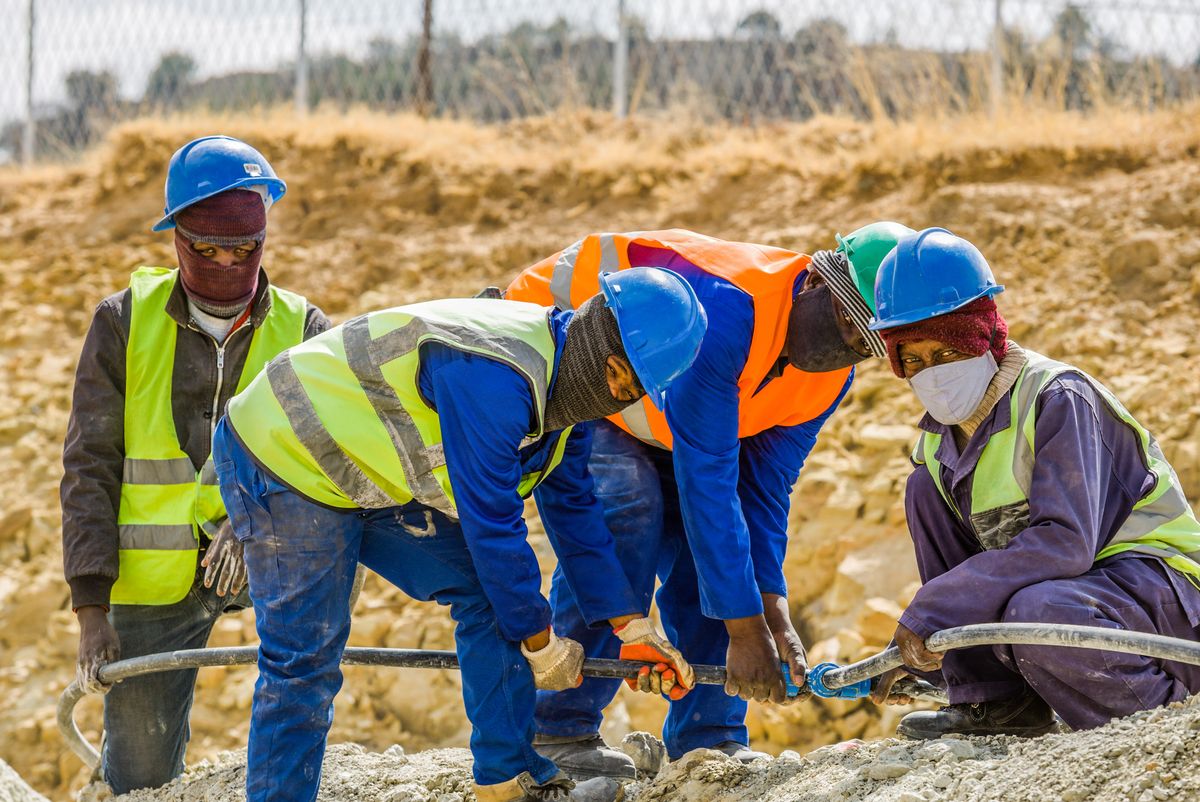
Water is consumed on every active construction site — for mixing concrete, curing slabs, suppressing dust, supplying ablution facilities for workers, cooling equipment, and maintaining the general welfare of site personnel. On most South African construction projects, the default assumption has been that this water comes from a municipal connection. That assumption deserves scrutiny.
Municipal water connection on a construction site takes time, costs money, and delivers a supply that is subject to the same interruptions, restrictions, and pressure inadequacies that affect the broader municipal network. For large sites, high-demand phases such as bulk concrete pours, or projects in areas with limited municipal infrastructure, these limitations are not minor inconveniences — they can directly delay programme.
A borehole drilled on the construction site at the outset of the project provides an on-site, immediately available, high-yield water source that is independent of municipal supply. Correctly planned, this same borehole can become the permanent water supply for the completed building — making it a capital investment in the asset, not merely a construction cost.
Why Construction Sites Need On-Site Water
The water demands of an active construction site are more varied and often more voluminous than the finished building will ever require. Understanding the specific uses helps to size the borehole system correctly from the start.
Concrete Mixing and Curing
Concrete requires water at two stages: during mixing, where the water-to-cement ratio is critical to strength and workability, and during curing, where water keeps the concrete surface moist for a defined period to prevent premature drying and cracking. On a large pour day — a suspended slab, a retaining wall, or a foundation raft — water consumption for concrete alone can run to thousands of litres. Supply interruptions on pour day are simply not acceptable.
Dust Suppression
Earthworks, excavation, and dry-weather site traffic generate significant quantities of airborne dust. Dust suppression — applying water to disturbed ground surfaces and haul roads — is a standard site management practice, both for worker health and to meet site neighbour obligations. A dedicated borehole supply for dust suppression, separate from the construction process water, ensures that suppression operations do not compete with other site water demands.
Ablution Blocks and Worker Welfare
South African construction sites are required to provide adequate toilet and ablution facilities for workers based on site headcount. On a large commercial or residential development with dozens or hundreds of workers, ablution facility demand is continuous and non-negotiable. Connecting these facilities to a borehole supply avoids the cost and lead time of a municipal connection and ensures supply continuity through load-shedding events and supply interruptions.
Equipment Cooling and Cleaning
Concrete mixer trucks, drilling rigs, and heavy plant require washing down. Compressor cooling systems in some applications require a water supply. On sites where brick or blockwork is being laid, water is needed for mortar mixing and for wetting masonry units. Cumulatively, these uses add meaningfully to daily water consumption and benefit from on-site supply.
Problems with Relying on Municipal Water on Construction Sites
The practical limitations of municipal water supply become most visible on construction sites, where demand is high, concentrated, and time-critical.
Supply interruptions: Municipal supply interruptions — from pipe bursts, scheduled maintenance, load-shedding-driven pump station failures, and reservoir drawdown — are unpredictable in timing and duration. On a residential construction project that can absorb a day's delay, this may be manageable. On a commercial project where programme delays carry financial penalties, a supply interruption on a critical activity day is a cost event.
Pressure inadequacy: Municipal reticulation pressure at a construction site connection may be lower than required for efficient use — particularly on sites at the end of long distribution mains, on high ground, or in areas where the network is under stress from competing demand. Low pressure slows filling operations and can make certain supply points unusable.
Connection delays and costs: Obtaining a temporary municipal water connection for a construction site requires an application, a waiting period, a connection fee, ongoing consumption billing, and in many municipalities, a deposit. In peri-urban or rural areas where no reticulation exists nearby, a connection may simply not be possible within any reasonable project timeframe. The alternative — water tankering — is expensive, logistically complex, and dependent on tanker scheduling that is outside the project's control.
Volume limitations: Municipal connections for construction sites are typically made through a standard meter connection. On high-demand days, the available flow through a single connection may be insufficient for simultaneous concrete mixing, dust suppression, and ablution supply — requiring either demand prioritisation (and the associated disruption) or multiple connections (and the associated cost).
The programme risk calculation: On any construction project with a fixed completion date, the cost of a water-related delay on a critical-path activity will typically exceed the cost of a borehole installation many times over. For project managers evaluating on-site water options, a borehole should be assessed against this benchmark — not just against the monthly municipal water bill.
Temporary vs. Permanent Borehole for Construction
The decision about whether to drill a construction borehole as a temporary measure or as a permanent asset shapes how it is specified, sited, and commissioned.
Temporary construction borehole: A temporary borehole is drilled for the specific purpose of supplying the construction phase, with no intention of retaining it for the completed building. This approach makes sense where the building's permanent water supply will be entirely municipal, or where the borehole location required for the construction phase is not suitable for permanent integration into the building's services. A temporary borehole may be drilled to a shallower specification and equipped with a rental pump and temporary pipework. At completion, it is decommissioned and sealed.
Permanent borehole commissioned during construction: The more cost-effective approach in most cases is to drill the permanent building supply borehole at the outset of the construction project and use it throughout the build phase. This requires the borehole to be sited and specified to its permanent function — depth, casing diameter, and pump capacity appropriate to the completed building's demand — while also meeting construction phase demand during the build.
The advantage of this approach is significant: the cost of the borehole, pump, and surface installation is borne as part of the construction budget but delivers a permanent building asset. There is no decommissioning cost and no double-handling of drilling and installation. The pump may need to be resized at handover — from a construction-volume high-flow unit to a correctly sized permanent building supply pump — but the borehole structure itself is complete and commissioned.
| Factor | Permanent Borehole (Built-in) | Temporary Borehole Only |
|---|---|---|
| Long-term value | ✔ Permanent building asset | Decommissioned at completion |
| Total cost | One drilling event, permanent pump | Temporary drill + decommission cost |
| Specification | Full permanent spec from the start | May be lighter spec, unsuitable for reuse |
| Siting flexibility | Must suit both phases; survey required | Sited for construction access only |
| Handover to owner | ✔ Seamless — already integrated | New borehole needed for permanent supply |
High-Demand Pumps for Construction: Sizing for the Site
Construction site water demand differs from residential demand in both volume and flow-rate profile. A residential borehole system might be sized to deliver 2–3 m³ per hour over a pump operating cycle of a few hours per day. A construction site may need to fill a 10 000 litre header tank in under an hour, then deliver simultaneous supply to a concrete mixer, a dust suppression bowser, and an ablution block — requiring both high instantaneous flow rates and reliable storage.
Pump sizing for a construction borehole should be based on a peak demand analysis that accounts for:
- The maximum simultaneous demand from all site uses at any point during the active build phase
- The storage tank volume and the time available for the pump to refill it between peak demand events
- The borehole's tested yield — the pump must not exceed the borehole's sustainable yield, even under peak construction demand
- The depth to the pumping water level, which determines the total dynamic head the pump must work against
For large commercial or infrastructure construction projects, this may mean specifying a 3-phase submersible pump in the 5–15 kW range, paired with a large-volume header tank (10 000 to 25 000 litres) on a purpose-built elevated stand. The header tank provides the buffer between pump output and peak site demand, ensuring that high-flow events can be met without the pump running beyond its capacity.
Where the borehole yield is assessed to support it, a second pump or a parallel pumping circuit can be installed on the same borehole for dedicated dust suppression supply — preventing competition between dust suppression and process water demand during simultaneous peak operations.
Dust Suppression: Dedicated Boreholes and Multi-Pump Configurations
On large earthworks and civils projects — road construction, bulk earthworks for mixed-use developments, mine rehabilitation — dust suppression is a major and continuous water consumer. A single bowser tanker truck typically carries 10 000 to 20 000 litres and can cover a defined area, but refilling the bowser is a repeated cycle that requires a high-flow water source close to the site.
Two configurations work well for construction dust suppression from a borehole source:
Single borehole, second pump: Where the borehole yield supports it, a second submersible pump is installed at a different depth in the same borehole, on a separate rising main and control circuit. The primary pump supplies process water and ablutions; the second pump supplies a dedicated dust suppression filling point at fast flow rates. This is only appropriate where the borehole yield has been tested and confirmed to support the combined abstraction rate of both pumps simultaneously.
Dedicated dust suppression borehole: On large sites with very high dust suppression demand, a second dedicated borehole sited near the main earthworks area may be more practical than attempting to distribute all water from a single point. A geophysical survey covers the broader site area to identify the best target for each borehole location, and the drilling programme sequences both boreholes efficiently.
Why a Geophysical Survey Matters Even for Temporary Construction Boreholes
It is tempting to treat a temporary construction borehole as a lower-stakes proposition — if it underperforms, the build can still be supplied by tankering. This reasoning underestimates the cost of a failed or low-yield borehole.
A geophysical survey before drilling — even for a temporary construction borehole — is the single most cost-effective risk-reduction step available. On hard-rock terrain, which covers the majority of South Africa's inland provinces, productive groundwater is found in fractures and weathered zones that are not visible from the surface. Drilling without a survey is effectively random in these environments. The odds of a productive outcome improve significantly with a survey, and the cost of the survey is a small fraction of the cost of a dry or low-yield borehole followed by tankering for a six-month build programme.
Drill depth is site-specific — a geophysical survey is required to determine the appropriate target depth for any given site. Everest Drilling's commercial rigs can drill to depths up to 250 m where the hydrogeology and project demand warrant it. Everest Drilling guarantees the depth of the borehole as quoted and drilled.
For construction projects where timing is tight, the geophysical survey can be commissioned and completed before ground-breaking, so the borehole drilling can be scheduled as an early mobilisation item — providing water supply from the first active site days rather than being retrofitted later when demand is already pressing.
Post-Construction: Handing Over the Borehole to the Building Owner
Where the construction borehole has been specified and commissioned as the permanent building supply, the handover from contractor to building owner is a structured process that ensures the asset is properly documented and ready for long-term operation.
A complete borehole handover package should include:
- Borehole completion record: The driller's log showing the geological formations encountered at each depth interval, the casing installation details (casing type, diameter, depth of each section, screen position), and the depth of the completed borehole.
- Geophysical survey report: The pre-drilling survey report, including the interpreted section and the drill target recommendation, as a record of the hydrogeological basis for the borehole location.
- Yield test results: The airlift or pump test data from after drilling, showing the tested yield in litres per hour and the pumping water level at that yield — establishing the borehole's productive capacity on record.
- Pump specification and installation record: The make, model, power rating, setting depth, and rising main specification of the pump installation — essential for future maintenance and replacement.
- Control panel documentation: The wiring diagram, protection settings, and operating instructions for the pump control panel.
- Surface equipment: Details of the tank, float valve, pressure system, and any distribution pipework installed as part of the borehole system.
A building owner receiving a borehole system without this documentation is receiving an asset they cannot maintain, service, or insure effectively. Everest Drilling provides a full completion and handover package as standard for commercial borehole installations.
Everest Drilling's Commercial Rig Capacity
Construction and commercial borehole projects have requirements that go beyond standard residential drilling — larger diameter casings for higher yield, deeper target horizons in hard rock, and larger pump installations that require a wider borehole completion.
Everest Drilling operates heavy commercial rigs capable of drilling large-diameter boreholes in hard-rock formations across South Africa. For construction projects requiring wide-diameter completions — to accommodate large-diameter casings and high-yield pumps — the commercial rig programme is the appropriate specification.
Site access for commercial rigs requires planning. Everest Drilling's pre-mobilisation site assessment evaluates access routes, overhead clearances, ground conditions for rig placement, and any underground services that need to be located before drilling commences. For large construction sites with active plant and multiple contractors, this coordination is planned with the principal contractor's site management team in advance of the rig's arrival.
Contact Everest Drilling to discuss your construction project's water supply requirements — providing the site location, the project programme, an estimate of peak daily water demand, and the intended permanent water supply arrangement for the completed building will allow the most appropriate borehole specification and rig programme to be proposed.
Related Articles
Common Questions
Plan Your Construction Site Water Supply
Everest Drilling works with construction contractors and developers to plan, drill, and commission on-site borehole water supply from project inception. Contact us for a project-specific quotation.