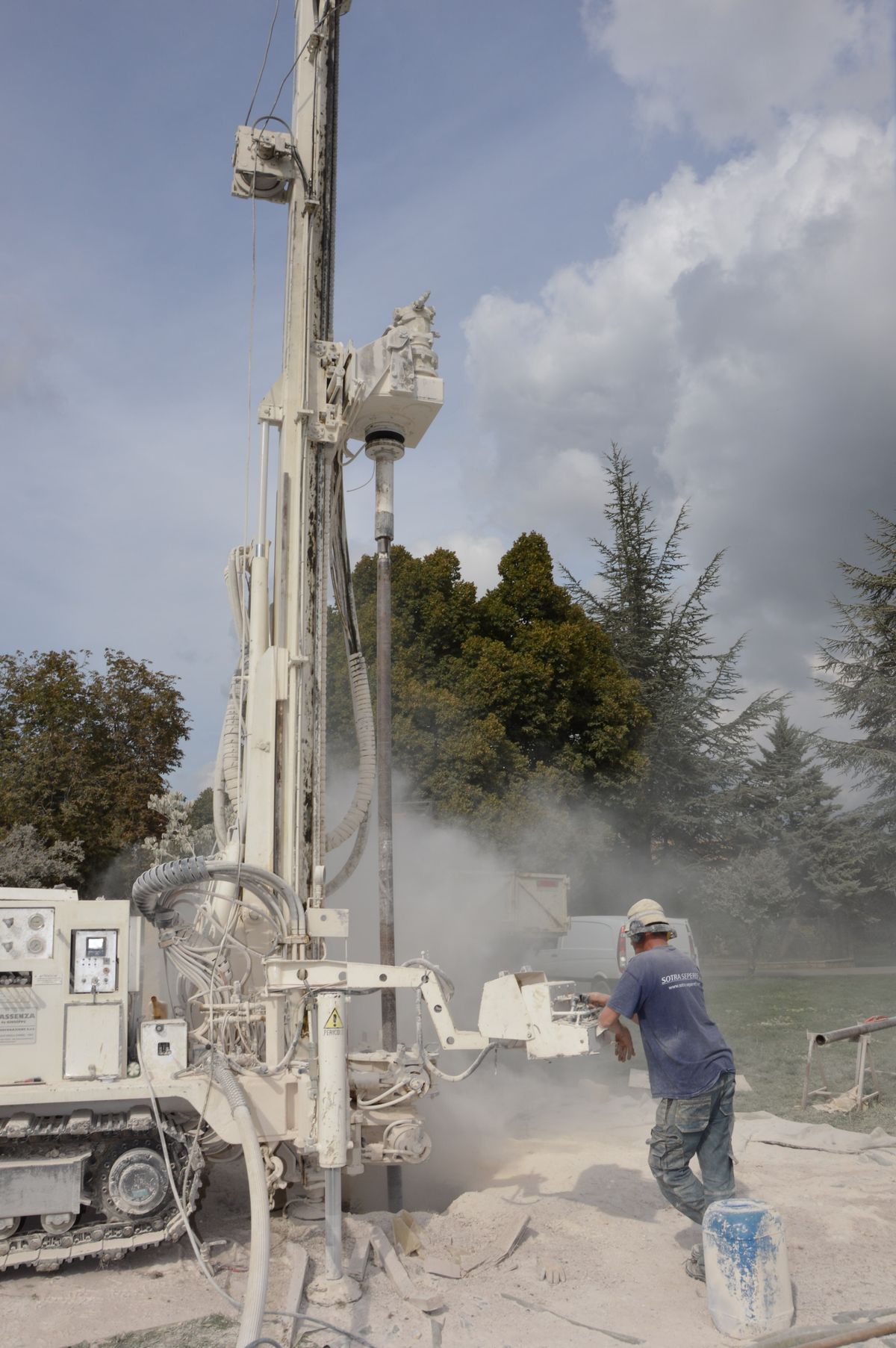
"How deep does a borehole need to be?" is one of the most common questions property owners ask before committing to a drilling project. The honest answer is that it depends — and it depends on factors that are specific to the geology beneath your property, not on a national average or a rule of thumb.
This article explains the geological and hydrogeological factors that drive borehole depth decisions across South Africa, with specific reference to the Eastern Cape, KwaZulu-Natal, and Gauteng. It also explains the role of geophysical surveying in identifying the optimal drill target, and why going deeper is not always the right answer.
Why Borehole Depth Varies So Much
South Africa sits on some of the world's oldest and most geologically varied rock formations. A borehole drilled on a farm in the Eastern Karoo encounters a fundamentally different geological environment from one drilled in coastal KwaZulu-Natal or in the hard quartzite ridges of Gauteng. These geological differences dictate where groundwater is found, how deep that groundwater sits, and how much effort is required to reach it.
The two fundamental controls on borehole depth are:
- Where groundwater is stored — in fractured rock, in porous sediment, or in a combination of both. Groundwater in fractured rock is found where fractures, joints, and fault zones create open pathways for water to accumulate. These features may occur at any depth, and identifying them requires a geophysical survey rather than guesswork.
- The depth to the water table — in some areas, the water table is close to the surface and a borehole of 30 to 40 metres strikes water. In others, the water table is deep and a borehole must reach 100 metres or more before encountering a productive zone. Seasonal variation, land use, and elevation all influence water table depth.
These two factors combine differently in different parts of the country, which is why a definitive depth cannot be specified for any site without site-specific investigation. Everest Drilling always recommends a geophysical survey before drilling to determine the optimal drill target depth for a specific property.
Eastern Cape: Karoo Supergroup and Dolerite Intrusions
The Eastern Cape is one of the most geologically interesting — and sometimes challenging — areas for borehole drilling in South Africa. The region is dominated by the Karoo Supergroup, a vast sequence of sedimentary rocks deposited between roughly 300 and 180 million years ago. These rocks — primarily mudstones, siltstones, and fine-grained sandstones — are relatively impermeable in their unaltered state and hold limited groundwater on their own.
What makes the Eastern Cape hydrogeologically productive is the widespread intrusion of dolerite — a dark, hard igneous rock that was injected as sills and dykes into the Karoo sediments during a period of volcanic activity roughly 183 million years ago. Dolerite itself is dense and impermeable, but the contacts between dolerite bodies and the surrounding Karoo sedimentary rock create fracture zones where water accumulates and moves. These contact zones are the primary drilling targets in the Eastern Cape interior.
In practice, this means:
- Borehole depths in the Eastern Cape typically range from 60 to 150 metres, depending on where the productive dolerite contacts and fracture zones are located at a given site.
- A borehole that terminates in the middle of a massive dolerite sill, having never reached the contact zone below, may encounter poor yield despite being relatively deep. Geophysical survey interpretation guides the driller to penetrate to the right depth, not just to stop at the first hard rock.
- In river valleys and alluvial flats — common in the Amathole region and around the Fish River — shallower boreholes into alluvial deposits can be productive at 20 to 40 metres.
- In the drier Karoo interior and the Great Karoo, water tables are generally deeper and more variable, and yields in purely sedimentary formations away from dolerite contacts tend to be modest.
KwaZulu-Natal: Coastal Sediments vs Inland Hard Rock
KwaZulu-Natal presents two distinct hydrogeological environments that produce very different depth profiles:
Coastal and peri-coastal KwaZulu-Natal — the coastal strip, particularly the area around Durban, Richards Bay, and southward toward the South Coast — is underlain by relatively young Cretaceous and Cenozoic sedimentary formations, including coastal sands, marine sediments, and alluvial deposits. These intergranular aquifers hold water in the pore spaces between grains and tend to be shallower and more predictable than fractured rock systems. Productive boreholes in these areas may strike water at 20 to 60 metres, and because the water is stored in connected pore space rather than discrete fractures, yields can be moderate to good across a wider range of drilling positions.
Inland KwaZulu-Natal — particularly the midlands, the Drakensberg foothills, and the escarpment regions — transitions into harder, older geological formations including basement gneisses, schists, and intrusive rocks. In these environments, borehole depths increase and productive fracture zones become the primary target, similar in principle to the Eastern Cape situation. Depths of 80 to 150 metres are common in these inland areas, with the actual target depth depending on the structural geology of the specific site.
The Zululand region in the north also features significant dune and coastal plain aquifers that can be productive at relatively shallow depths, while elevated inland areas of KZN tend toward deeper, harder-rock targets requiring more drilling effort.
Gauteng: Hard Quartzite and Granite of the Witwatersrand
Gauteng sits on some of South Africa's most ancient and hardest rocks. The Johannesburg area is dominated by the Witwatersrand Supergroup — the same gold-bearing quartzite and conglomerate sequence that made the region famous — overlaid in places by younger Transvaal Supergroup formations including dolomite, shale, and quartzite. Surrounding the Witwatersrand rocks are extensive areas of granite and gneiss of the Archean Kaapvaal Craton, some of the oldest exposed rocks on Earth.
Drilling in Gauteng means working in extremely hard rock. Progress rates on the rig are slower per metre than in softer formations, and the drilling cost per metre is correspondingly higher. However, hard rock does not mean dry rock — fractures in quartzite and granite can be highly productive water sources where they occur.
The key hydrogeological targets in Gauteng are:
- Fractured quartzite along joint systems and fault zones in the Witwatersrand sequence — typically found at 40 to 120 metres depth in these formations.
- Dolomite formations of the Chuniespoort Group, which are found in parts of the West Rand, Pretoria area, and north of Johannesburg. Dolomite dissolves in groundwater, creating cave systems and large void spaces that can yield very high volumes of water — but dolomite areas require careful geotechnical assessment for infrastructure safety reasons before drilling.
- Fractured granite in the surrounding crystalline basement — productive fracture zones in Archean granite are sometimes encountered at 60 to 150 metres, but the granite is variable and a geophysical survey is particularly valuable in guiding the drill position.
Depth guarantee: Everest Drilling guarantees the depth of the borehole as quoted and drilled. The quoted depth is determined by the geophysical survey interpretation and the hydrogeological assessment of the specific site. You receive the depth you pay for — no less.
How a Geophysical Survey Determines Optimal Drill Depth
Because borehole depth is site-specific, the most reliable way to determine the optimal drill target before committing to drilling is a geophysical survey. This is a non-invasive surface investigation that uses electrical, electromagnetic, or seismic methods to image the subsurface and identify structures that are likely to host groundwater.
The survey output — typically a resistivity profile or a combination of survey methods interpreted by a hydrogeologist — identifies:
- The approximate depth to productive fracture zones or aquifer formations
- The position of dolerite contacts in Karoo geology
- Fault zones and linear structural features that often serve as conduits for groundwater movement
- Changes in rock type at depth that might indicate transitions between dry and water-bearing formations
Armed with this information, the drilling team can target the correct depth with confidence — stopping where the geology indicates a productive zone rather than drilling blindly to a generic depth. This reduces both the cost of unnecessary extra drilling and the risk of a dry or low-yield borehole.
The requirement for a geophysical survey is particularly important on sites where surface indicators are ambiguous, where previous boreholes in the area have been unsuccessful, or where the geology is complex (such as mixed Karoo sediments and dolerite, or variable alluvial coverage over crystalline basement). The depth is site-specific — and the survey is how you find out what that depth should be.
Why Deeper Is Not Always Better
A common misconception is that drilling deeper will always produce more or better water. This is not true, and drilling unnecessarily deep creates real costs and complications:
Cost. Drilling cost is almost always quoted per metre. Every metre drilled is money spent. If the productive fracture zone was reached at 80 metres and the drilling continued to 150 metres without encountering additional water-bearing features, 70 metres of drilling cost was wasted. The geophysical survey is specifically aimed at avoiding this situation.
Pump selection complexity. A deeper borehole means a higher total dynamic head for the pump to work against. A pump that is adequate for a 60-metre borehole may be entirely undersized for a 150-metre borehole with a similar yield, because the additional head requirement reduces the pump's output on its performance curve. Deeper boreholes require more powerful pumps and larger rising-main diameters to manage friction losses — increasing the cost of the pump installation as well as the operating energy cost.
Water temperature. Very deep groundwater in some formations emerges at elevated temperatures — a practical inconvenience for domestic use where cool water is expected, and a consideration for livestock watering in summer.
Diminishing returns in fractured systems. In fractured aquifer settings, the most productive fracture zones are often at intermediate rather than maximum depths. Once the drill has passed the productive zone and entered a different, less fractured rock type below, additional depth simply costs money without adding to yield. Knowing where to stop — informed by the drilling log and the geophysical survey interpretation — is as important as knowing where to start.
Everest Drilling drills boreholes up to 250 metres where the site-specific geology requires that depth to reach a productive aquifer. But in the majority of installations across the Eastern Cape, KwaZulu-Natal, and Gauteng, the optimal depth is considerably shallower — determined by the survey, confirmed by the drilling log, and guaranteed as delivered.
Related Articles
Common Questions
Find Out How Deep Your Borehole Needs to Be
A geophysical survey determines the optimal drill depth for your specific site. Contact Everest Drilling for a project-specific quotation — Eastern Cape, KwaZulu-Natal, and Gauteng.