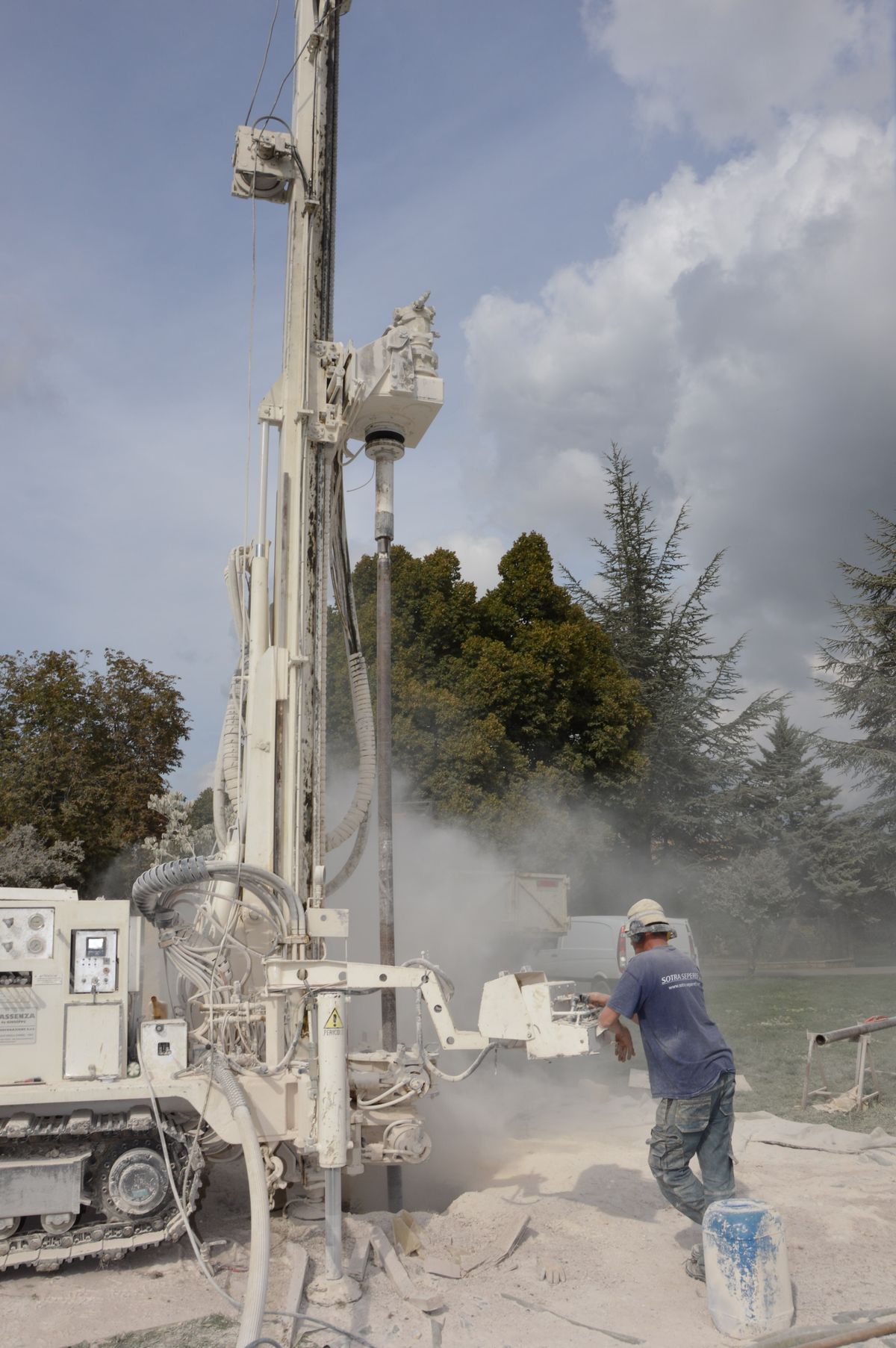
Once the drill rig has reached depth and found water, the real engineering work of a borehole begins: casing. Casing is the permanent pipe structure that lines the borehole from surface to depth, and it determines how well the borehole performs over its entire lifespan. Choose the wrong casing material, diameter, or design, and a successful drilling result can turn into a problem within a few years. Choose correctly, and a borehole can deliver clean, reliable water for decades.
This article explains what borehole casing is, why it matters, the difference between steel and uPVC casing, how casing diameter affects your pump options, and what happens with gravel packing and sealing during installation. We also look at how Eastern Cape geology influences casing design — particularly the role of dolerite intrusions and competent rock zones.
What Is Borehole Casing and Why Is It Necessary?
Borehole casing is the structural liner installed inside a drilled hole. Its job is threefold: prevent the borehole walls from collapsing, exclude formation material from the water column, and create an annular seal between the surface and the water-bearing zone to prevent contamination from entering the borehole from above.
Without casing, a borehole drilled through soft, unconsolidated, or weathered material would cave in — either immediately or gradually over months. Even in harder rock, the upper weathered zone almost always requires casing to maintain the integrity of the hole. Casing also acts as the housing for the submersible pump: the pump is lowered inside the casing and sits within it, drawing water up through the pipe to surface.
The design of the casing — material, diameter, depth of installation, screen position, seal quality — has more influence on long-term borehole performance than almost any other single factor. A borehole drilled into a productive aquifer but with poorly designed or installed casing will underperform, silt up, or fail prematurely. Getting the casing right is as important as finding water in the first place.
There are two fundamental considerations in casing design. The first is the solid section: this extends from the surface down through unstable overburden and weathered rock, preventing collapse and sealing out surface water and contaminated shallow groundwater. The second is the screen section: this is the slotted or perforated portion installed opposite the water-bearing zone of the aquifer, allowing groundwater to flow freely into the borehole while preventing the movement of aquifer material into the water column.
Steel Casing: When It's Used and Why
Steel casing is the traditional material for borehole construction and is still specified in situations where the mechanical demands exceed what PVC can handle. It is heavier, stronger, and more resistant to distortion under load — but also more expensive and, without protective treatment, susceptible to corrosion in certain water chemistries.
Steel casing is typically specified for the following applications:
- Unstable or heavily fractured overburden. Where the formation is extremely loose, unconsolidated, or subject to ground movement, steel provides structural rigidity that uPVC cannot match. This includes deep alluvial deposits, mine spoil zones, and highly weathered granite profiles.
- Heavy-rig boreholes. Large-diameter boreholes drilled with air-rotary or down-the-hole (DTH) hammer rigs for high-yield industrial and municipal applications often use steel casing because the installation process — driving the casing into the formation using the hammer — is not suited to PVC.
- Industrial and municipal supply boreholes. Where the borehole must support a large-diameter, high-capacity pump and will be subject to decades of high-demand operation, steel provides the mechanical durability required.
- High-pressure or deep applications. In some geological settings, formation pressures or the sheer weight of water column and pump string exceed the load-bearing capacity of PVC casing. Steel is the material of choice at depth under these conditions.
- Permanent casing in the upper section of composite boreholes. Even in boreholes where the lower section is uPVC or open hole, steel may be used for the surface conductor casing — the upper few metres that must withstand the mechanical stresses of drilling and installation.
The primary disadvantage of steel casing is weight and cost. Steel casing is significantly heavier to transport and handle, requires welding or threaded connections, and is more expensive per metre than uPVC. In aggressive groundwater chemistries — particularly where water is acidic or has high chloride content — galvanic corrosion can progressively reduce the wall thickness of steel casing over time. Stainless steel addresses this but at a further cost premium, making it the exception rather than the rule in South African residential and agricultural borehole construction.
uPVC Casing: The Standard for Residential and Agricultural Boreholes
Unplasticised polyvinyl chloride — uPVC — has become the dominant casing material for residential, agricultural, and light commercial boreholes across South Africa. It is lighter than steel, more corrosion-resistant, easier to handle and join, and available in a range of diameters and wall thicknesses suited to the full spectrum of South African groundwater applications.
uPVC casing is manufactured in plain (solid) and slotted (screen) configurations. The solid casing forms the upper section of the installation, from the surface down through the non-productive formation. Below the water-bearing zone, the solid casing transitions to screen casing — a section with precisely milled horizontal or bridge-slot perforations that allow water to enter while retaining aquifer sediment.
Key advantages of uPVC casing for South African boreholes include:
- Corrosion resistance. uPVC does not rust or corrode regardless of water chemistry. It is inert to the range of dissolved minerals typically found in South African groundwater — including iron, manganese, and moderate sulphate concentrations.
- Lightweight installation. uPVC is significantly easier to handle on site than steel, reducing installation time and the physical demands on the drilling crew. Sections are joined using threaded or glued couplings rather than welding.
- Long service life. In most South African groundwater environments, uPVC casing has a service life of several decades. It is not subject to the degradation mechanisms that affect steel, and the material does not leach into the water column.
- Available in multiple wall thicknesses. uPVC casing for boreholes is heavier-walled than standard plumbing PVC — typically Class 6, Class 9, or Class 12 pressure rating — providing the structural rigidity needed to resist formation pressure in the borehole annulus.
For the vast majority of farm boreholes, smallholding supplies, residential boreholes, and light commercial applications across the Eastern Cape, Karoo, and KwaZulu-Natal, uPVC casing is the appropriate and cost-effective choice.
Casing Diameter: 110mm, 140mm, 160mm, 200mm and What Each Means for Pump Selection
The internal diameter of the borehole casing directly determines which submersible pumps can be installed — and therefore what yield the system can practically achieve. This is one of the most important decisions made before drilling begins, because the hole diameter must be sized to accommodate the intended casing from the outset.
| Casing OD | Typical Application | Pump Diameter Range |
|---|---|---|
| 110mm | Low-yield residential boreholes, smallholdings, single-household supply | 3-inch (75mm) submersible pumps |
| 140mm | Residential to light agricultural; common for solar pump applications | 4-inch (100mm) submersible pumps |
| 160mm | Agricultural boreholes, moderate-yield irrigation supply, game farms | 4-inch to 5-inch pumps |
| 200mm and above | High-yield agricultural, industrial, municipal boreholes | 6-inch and larger pumps; multi-stage high-capacity units |
Selecting too small a casing diameter limits your future pump options — if the aquifer turns out to be more productive than anticipated, you cannot install a higher-capacity pump in an undersized casing. This is why Everest Drilling typically recommends sizing up where there is uncertainty about yield, particularly for agricultural applications where future water demand may grow.
The outside diameter (OD) of the casing must also be considered in relation to the drilled hole diameter. A minimum annular clearance between the casing OD and the drilled hole wall is required for gravel packing and annular sealing — typically at least 50mm on each side for adequate gravel pack placement.
Everest Drilling guarantees the depth of the borehole as quoted and drilled. Casing specification, diameter, and design are determined at the quotation stage based on site assessment and intended application. Any changes to the casing design after drilling commences — for example, if geology encountered at depth requires a different approach — are discussed with the client before proceeding.
Gravel Packing and Annular Sealing
Once the casing string has been installed in the borehole, the annular space between the outside of the casing and the borehole wall must be filled and sealed. This is done in two distinct zones, each with a different material and purpose.
Gravel pack (also called filter pack) is placed in the annular space opposite the screen section of the casing. It consists of specially graded, clean, rounded gravel or coarse sand — sized to bridge the screen slots and to be coarser than the aquifer material the screen is retaining. The gravel pack performs two functions: it supports the aquifer face immediately outside the screen, preventing fine material from migrating inward, and it creates a high-permeability pathway for groundwater to move from the aquifer toward the screen with minimal resistance. A correctly designed and placed gravel pack dramatically improves borehole yield and longevity by stabilising the aquifer face and maintaining open flow paths over time.
Above the gravel pack, in the solid casing section, the annular space is sealed with bentonite (a swelling clay) or cement grout. This seal is critical — it prevents surface water, shallow soil water, or contaminated near-surface groundwater from flowing down the annulus and entering the water-bearing zone inside the casing. Without a properly installed annular seal, even a deep borehole can be susceptible to quality deterioration from shallow sources over time.
The surface termination of the borehole — the wellhead — is then completed with a concrete apron around the casing to prevent surface runoff from pooling at the casing head, and a lockable cap to protect the borehole interior from insects, surface debris, and interference.
Eastern Cape Specifics: Dolerite, Weathered Overburden, and Open Hole Completions
The Eastern Cape presents a distinctive geological picture that directly influences casing design. The province is underlain predominantly by rocks of the Karoo Supergroup — mudstones, siltstones, and sandstones — extensively intruded by dolerite dykes and sills. These dolerite bodies are the most common fractured-rock aquifer targets in much of the interior Eastern Cape and Karoo fringe, and they influence not just where water is found but how the borehole must be constructed to reach it.
In a typical Eastern Cape borehole, the geological column from surface downward looks something like this:
- Topsoil and colluvium (0–3m): Loose material requiring casing from the outset.
- Weathered rock (3–20m typically, sometimes deeper): Soft, fractured, and unstable Karoo sediment — the zone that most commonly caves and must be cased. This is where solid uPVC or steel conductor casing is set.
- Transition zone: Where weathered rock gives way to harder, more competent material. The degree of weathering varies significantly across the Eastern Cape — coastal hinterland areas tend to have deeper weathering profiles than the drier interior.
- Competent rock (variable depth): Hard Karoo sedimentary rock or dolerite intrusion. Once the borehole enters truly competent rock that will not cave, casing is typically not required — the borehole is completed as open hole through this section.
The open hole completion in competent rock is important: it means the water-bearing fractures in the dolerite or hard Karoo sediment are not obstructed by casing. Water flows directly from the fractures into the open borehole and rises to the rest water level under natural artesian pressure or gravity. This maximises yield from the productive zone and avoids the cost and complexity of screening a hard-rock section where the formation material is stable.
Coastal Eastern Cape formations — particularly in the Buffalo City, East London, and Wild Coast hinterland areas — often include softer alluvial and colluvial materials that extend deeper and require more extensive solid casing before competent rock is reached. The depth at which casing can be terminated and open hole can begin varies significantly from site to site, which is why experienced drillers monitor the formation material carefully as drilling progresses.
Depth to water and total drilling depth in the Eastern Cape are site-specific. A geophysical survey is the essential first step for any new borehole — it maps subsurface fractures and gives a target depth before drilling begins. Depths of up to 250m are achievable with Everest Drilling's equipment.
How Long Does Borehole Casing Last?
The service life of borehole casing depends on the material, the groundwater chemistry, and the quality of installation. In ideal conditions, a well-installed uPVC casing in neutral-chemistry groundwater should last 30 to 50 years or more. The casing itself — being chemically inert and structurally stable — does not degrade in most South African groundwater environments.
The factors most likely to cause premature casing failure or performance decline are:
- Mechanical damage during pump installation or servicing. Dropping tools, forcing oversized equipment, or incorrect pump extraction can damage or crack PVC casing. Using correctly sized equipment and working carefully during servicing protects the casing throughout the borehole's life.
- Biofouling and iron bacteria. In groundwater with elevated iron concentrations, iron-reducing bacteria can form encrusting deposits on the screen slots and gravel pack, progressively reducing flow into the borehole. This is managed by periodic borehole rehabilitation — jetting or chemical treatment of the screen zone.
- Sand ingress through damaged screen. If the screen slots are incorrectly sized or the gravel pack is displaced, aquifer sand can migrate into the borehole and accumulate at depth. This reduces effective casing length and can damage the pump impellers over time. It is generally addressed during construction rather than retrofitting.
- Gravel pack collapse. In very deep or large-diameter boreholes, the gravel pack can settle or bridge over time. This is rare with correctly installed packs but can be observed in older boreholes and is addressed during rehabilitation.
Steel casing has a shorter practical service life in aggressive groundwater chemistries. In iron-rich, acidic, or high-chloride groundwater — which occurs in parts of the Eastern Cape coastal zone and some Karoo formations — steel casing can show significant corrosion within 10 to 20 years. uPVC is generally the preferred material in these environments precisely because of its corrosion resistance.
A properly cased borehole, installed with the right materials for the local geology and groundwater chemistry, requires minimal intervention over its service life. The casing is designed to be a permanent installation — set in place during construction, left in situ for the life of the borehole, and accessed only through the wellhead above ground when the pump requires servicing or replacement.
Related Articles
Common Questions
Talk to Us About Your Borehole
Every borehole is designed around your site's geology. Contact Everest Drilling for a project-specific assessment and quotation.